Dimensions: 112 × 169 mm (image); 122 × 190 mm (plate); 182 × 249 mm (sheet)
Copyright: Public Domain
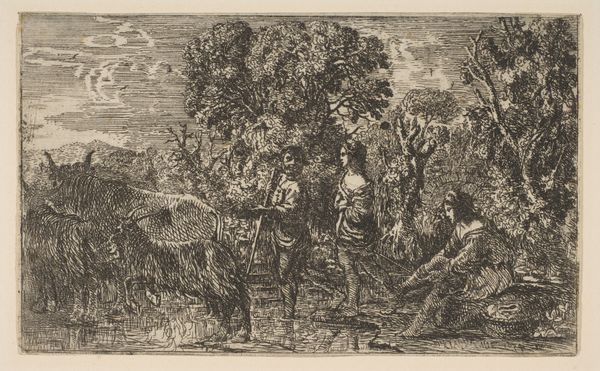
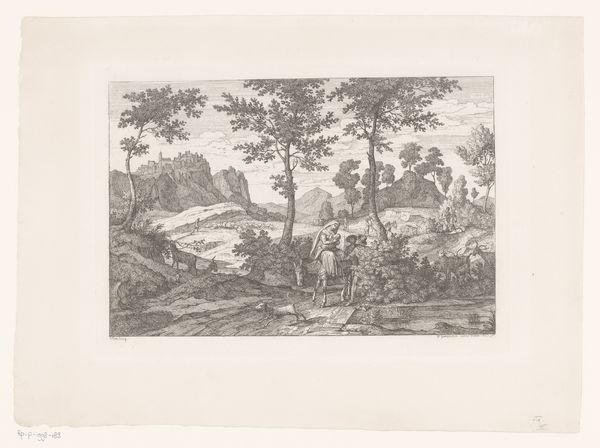
Editor: This is Heinrich Reinhold’s "Arcadian Shepherd Boy and His Flock of Sheep" from 1810. It's an etching on paper, and something about the pastoral scene, with the shepherd almost blending into the trees, feels quite romantic, and also makes me consider genre painting. How do you interpret this work within its historical context? Curator: Well, considering Reinhold's place within early 19th-century Germany, this piece offers a glimpse into the prevailing Romantic ideologies. These landscapes weren't merely depictions of nature; they were often imbued with nationalist sentiments, representing an idealized vision of the homeland and its people. Where do you see this ideal being presented? Editor: Maybe in the calm order? Even the dog seems well-behaved as it directs the sheep! There is definitely an idyllic sense to it, although…doesn’t life on the farm always have difficulties? Curator: Exactly! The artwork promotes an idealized view of rural life, omitting any hardships the lower class would face at that time, doesn't it? The representation of shepherds and idealized rural settings also became associated with a longing for a simpler, pre-industrial past. What could be the social impact? Editor: It seems that by presenting this view, it glossed over some of the societal inequalities present in the moment? Did showing this in galleries play a role in society and culture at the time? Curator: Certainly, such representations served a purpose. Museums and galleries often curate and present works that align with certain national narratives, and Reinhold's etching could be seen as contributing to a sense of national identity and cultural pride while subtly reinforcing social hierarchies. It prompts questions about the social and political forces that influenced artistic production and reception. Editor: It is more than just a quaint image! Thank you; that’s something I will look for in future works from the period.
Comments
No comments
Be the first to comment and join the conversation on the ultimate creative platform.
 Collect
 React
React Comment
More like this