drawing, graphic-art, intaglio
#
drawing
#
graphic-art
#
conceptual-art
#
neat line work
#
intaglio
#
architectural diagram
#
crosshatching
#
structure design
#
abstract
#
linework heavy
#
3d shape
#
geometric
#
thin linework
#
architectural proposal
#
technical line art
#
intricate and detailed
Copyright: M.C. Escher,Fair Use
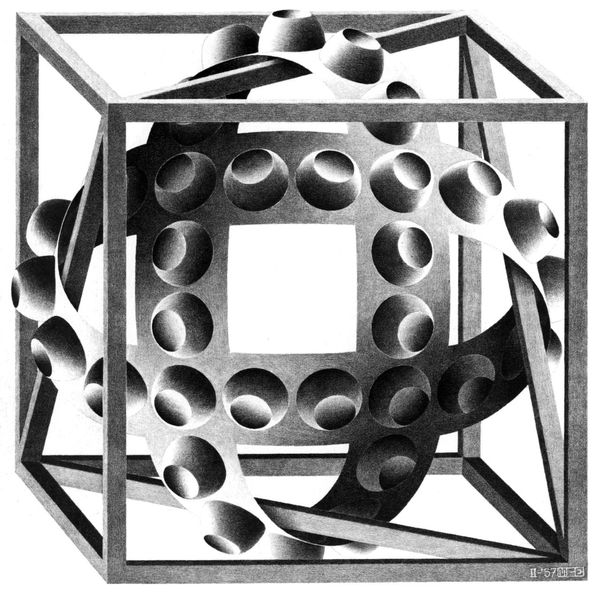
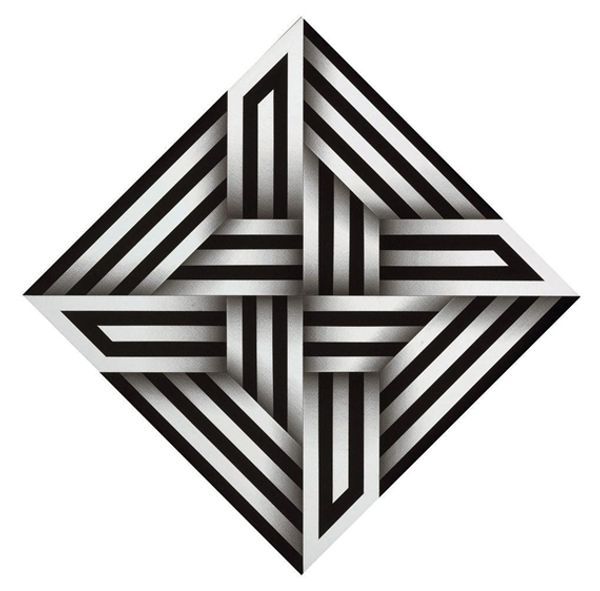
Curator: The artwork before us is "Knot," a 1966 intaglio and drawing by the renowned M.C. Escher. What are your first impressions? Editor: Oh, wow. It feels like a Mobius strip had a baby with an origami swan...a very anxious baby. It’s dense and kind of disorienting, but there's an almost hypnotic rhythm to it. Curator: Indeed. Escher, even as a mathematician as well as an artist, often explored themes of infinity, impossible constructions, and the interplay between dimensions. This work sits squarely within his investigations of tessellations, spatial illusions, and topological paradoxes. Look at how he uses thin linework and crosshatching. What socio-political anxieties do you believe are embedded? Editor: I see it. Anxieties? Hmm, I bet for Escher, the political anxieties were internal battles with perspective and dimension! I kid, but maybe it's about the confines of our perception and how systems of belief create these self-contained loops. Curator: Interesting. Considering post-war existentialism and the Cold War context, do you see Escher engaging with a sense of entanglement in systems beyond individual control? Editor: That's heavy. But I also get this feeling that there's humor in it too. Like, we're taking all these impossible shapes and existential worries so seriously, but isn't the real magic in the elegant, absurd mess? Curator: That echoes aspects of absurdist theatre from the era. Escher seems to hold a mirror to our human drive for order, exposing its inherent contradictions and limitations within social and mathematical contexts. Editor: Okay, professor! But speaking of limits…it makes me think about creative limitations and pushing past boundaries by using limitations. Escher seems to be turning these confines into pathways towards new aesthetic possibilities. Curator: A compelling observation on artistic and social resistance through paradoxical creativity. "Knot" uses meticulous craft to interrogate boundaries, mathematical, and conceptual, inviting the audience to question perception and reality. Editor: True, very true. Ultimately it’s that push and pull between anxiety and amusement that lingers for me. The deeper you look, the loopier it gets. Curator: And sometimes it is in the loopiness we come closest to understanding a fundamental reality.
Comments
No comments
Be the first to comment and join the conversation on the ultimate creative platform.
 Collect
 React
React Comment
More like this