drawing, print, engraving
#
portrait
#
drawing
#
16_19th-century
# print
#
charcoal drawing
#
genre-painting
#
academic-art
#
engraving
#
realism
Copyright: Public domain
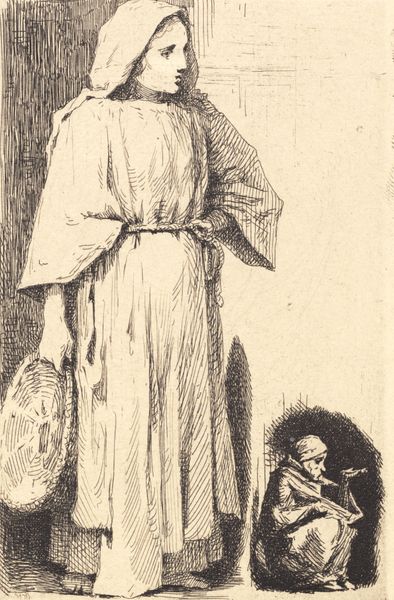
Editor: This is Alexandre Antigna's "Palm Seller, Scene of City Life," created in 1866. It looks like a print or drawing. The image depicts a young girl standing against a stone wall, and there's a definite feeling of poverty or sadness. What do you see in this piece? Curator: I see a stark commentary on social inequalities during the 19th century. Antigna’s choice of realism immediately pulls us into the world of this young girl, and we must consider her position. Where does she fit in the Parisian narrative? Note the palm branches she sells; they signify not wealth, but potentially a desperate attempt to survive. Editor: She does look very vulnerable. What is emphasized here? Curator: Everything in this artwork calls attention to the child's marginalized existence. Consider the context: The 1860s in France were marked by rapid industrialization and urbanization, creating both wealth and deep poverty. Antigna brings that social stratification into sharp focus. Even the stone wall is meaningful—it acts almost as a barrier. Who constructed it, and whom does it keep out? What are your thoughts? Editor: I guess I hadn't really considered all those societal elements, but it makes sense now. Is this image portraying social commentary or simply representing daily life at the time? Curator: It is definitely both, but perhaps not as straightforwardly as it initially seems. I think that by representing the subject matter, Antigna encourages a call for recognition and, potentially, change. This work compels viewers to engage with uncomfortable truths and confront systemic problems that continue to affect many people today. Editor: Wow, I’ve gained so much more from that single image. The artist truly knew what they were doing! Curator: Exactly! Art becomes a catalyst, urging society toward a more equitable existence, or at least urging its contemplation.
Comments
No comments
Be the first to comment and join the conversation on the ultimate creative platform.
 Collect
 React
React Comment
More like this