About this artwork
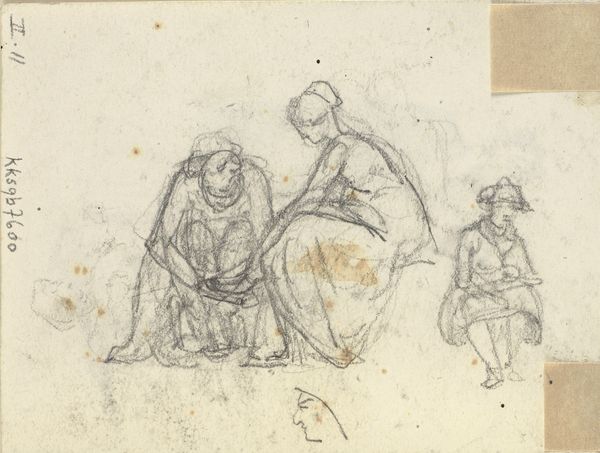
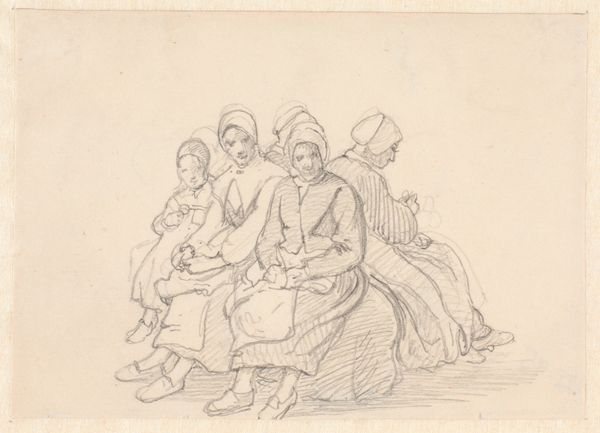
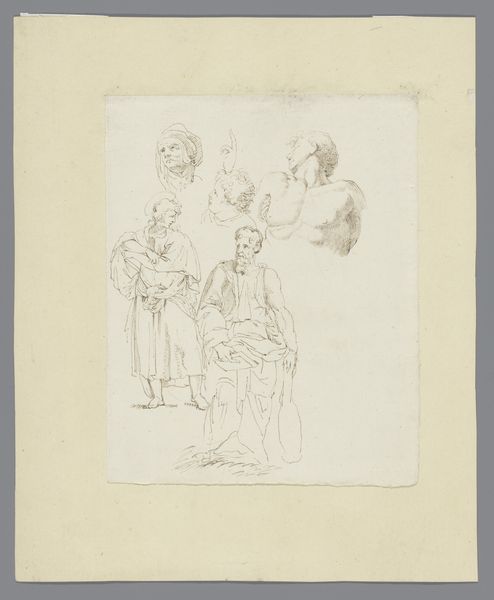
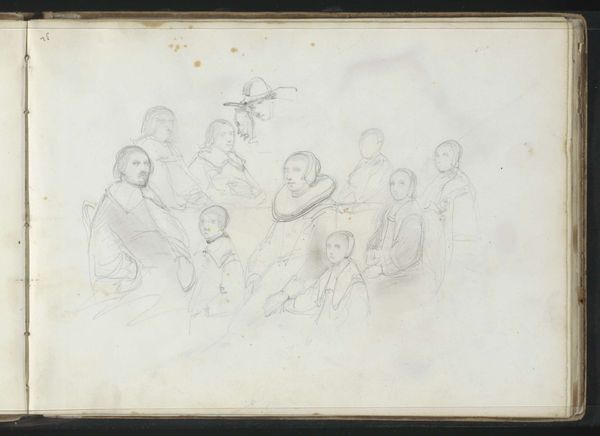
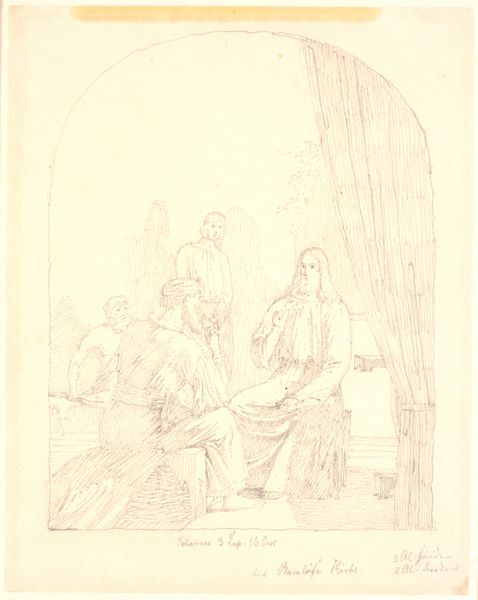
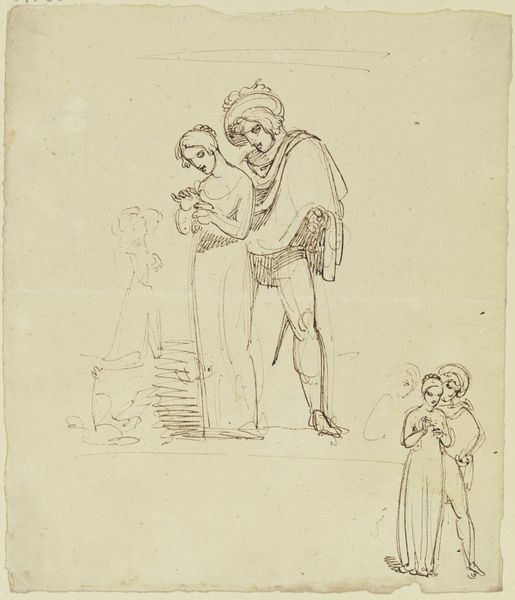
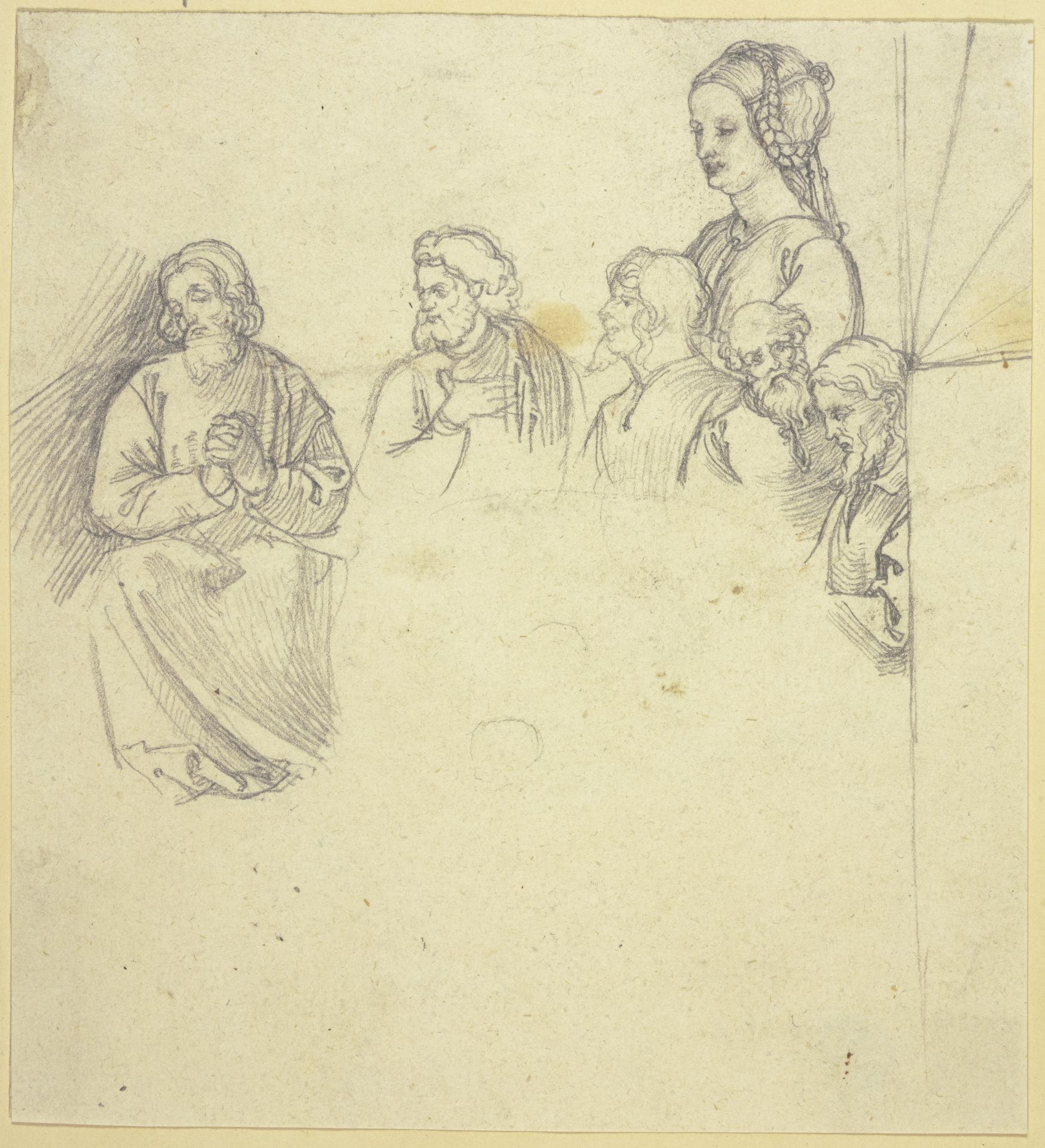
Editor: This is a drawing titled "Fünf heilige Männer, dabei eine Frau" by Joseph Bucher, held at the Städel Museum. It seems to be a preliminary sketch, perhaps in pencil, with the figures rather loosely rendered. What compositional elements stand out to you? Curator: Initially, the dynamism—or lack thereof—captures my attention. Observe the spatial arrangement: the figures are clustered, yet each retains a certain independence. Notice how the artist utilizes line weight and density to define form. Where does your eye travel first, and why? Editor: I'm drawn to the figure on the left, the one with hands clasped as though in prayer. His posture creates a strong diagonal. Then my eyes follow the group towards the right, ending on the woman with elaborate braids. Does this hierarchy of detail guide the viewer? Curator: Indeed. Note how the sharper lines create emphasis. But, is this just a straightforward sketch, or is Bucher hinting at a narrative through the interplay of these figures? Is the tonal quality deliberately evocative? Editor: I hadn’t thought of narrative! It feels like an intimate glimpse into Bucher’s process. Does the roughness diminish its artistic merit, or does it become another dimension in the artist’s work? Curator: Roughness is a curious measure. Consider the intent: does it successfully utilize formal tools in service of his aim? Editor: Looking closer, the "imperfections" create movement and energy. This exploration of line and form now seems much more intentional. Curator: Precisely. Recognizing the delicate interplay allows a richer experience of the artwork.


Artwork details
- Medium
- drawing, pencil
- Location
- Städel Museum
- Copyright
- Public Domain
Tags
portrait
drawing
amateur sketch
toned paper
light pencil work
medieval
pencil sketch
figuration
personal sketchbook
ink drawing experimentation
pencil
sketchbook drawing
pencil work
watercolour illustration
sketchbook art
Comments
No comments
About this artwork
Editor: This is a drawing titled "Fünf heilige Männer, dabei eine Frau" by Joseph Bucher, held at the Städel Museum. It seems to be a preliminary sketch, perhaps in pencil, with the figures rather loosely rendered. What compositional elements stand out to you? Curator: Initially, the dynamism—or lack thereof—captures my attention. Observe the spatial arrangement: the figures are clustered, yet each retains a certain independence. Notice how the artist utilizes line weight and density to define form. Where does your eye travel first, and why? Editor: I'm drawn to the figure on the left, the one with hands clasped as though in prayer. His posture creates a strong diagonal. Then my eyes follow the group towards the right, ending on the woman with elaborate braids. Does this hierarchy of detail guide the viewer? Curator: Indeed. Note how the sharper lines create emphasis. But, is this just a straightforward sketch, or is Bucher hinting at a narrative through the interplay of these figures? Is the tonal quality deliberately evocative? Editor: I hadn’t thought of narrative! It feels like an intimate glimpse into Bucher’s process. Does the roughness diminish its artistic merit, or does it become another dimension in the artist’s work? Curator: Roughness is a curious measure. Consider the intent: does it successfully utilize formal tools in service of his aim? Editor: Looking closer, the "imperfections" create movement and energy. This exploration of line and form now seems much more intentional. Curator: Precisely. Recognizing the delicate interplay allows a richer experience of the artwork.
Comments
No comments