About this artwork
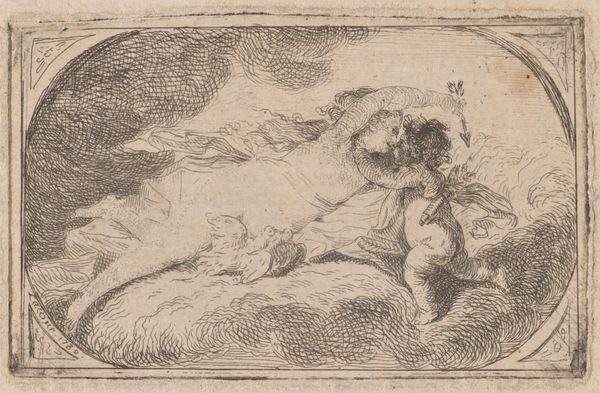
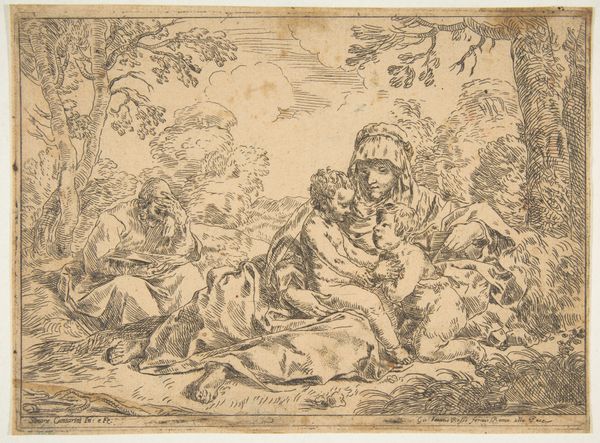
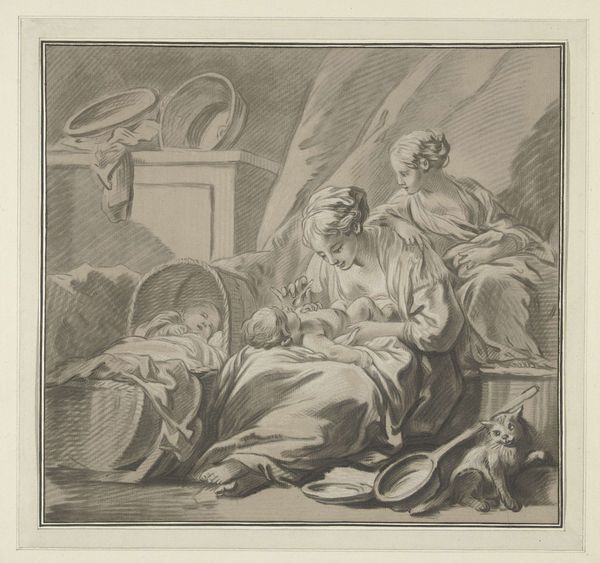
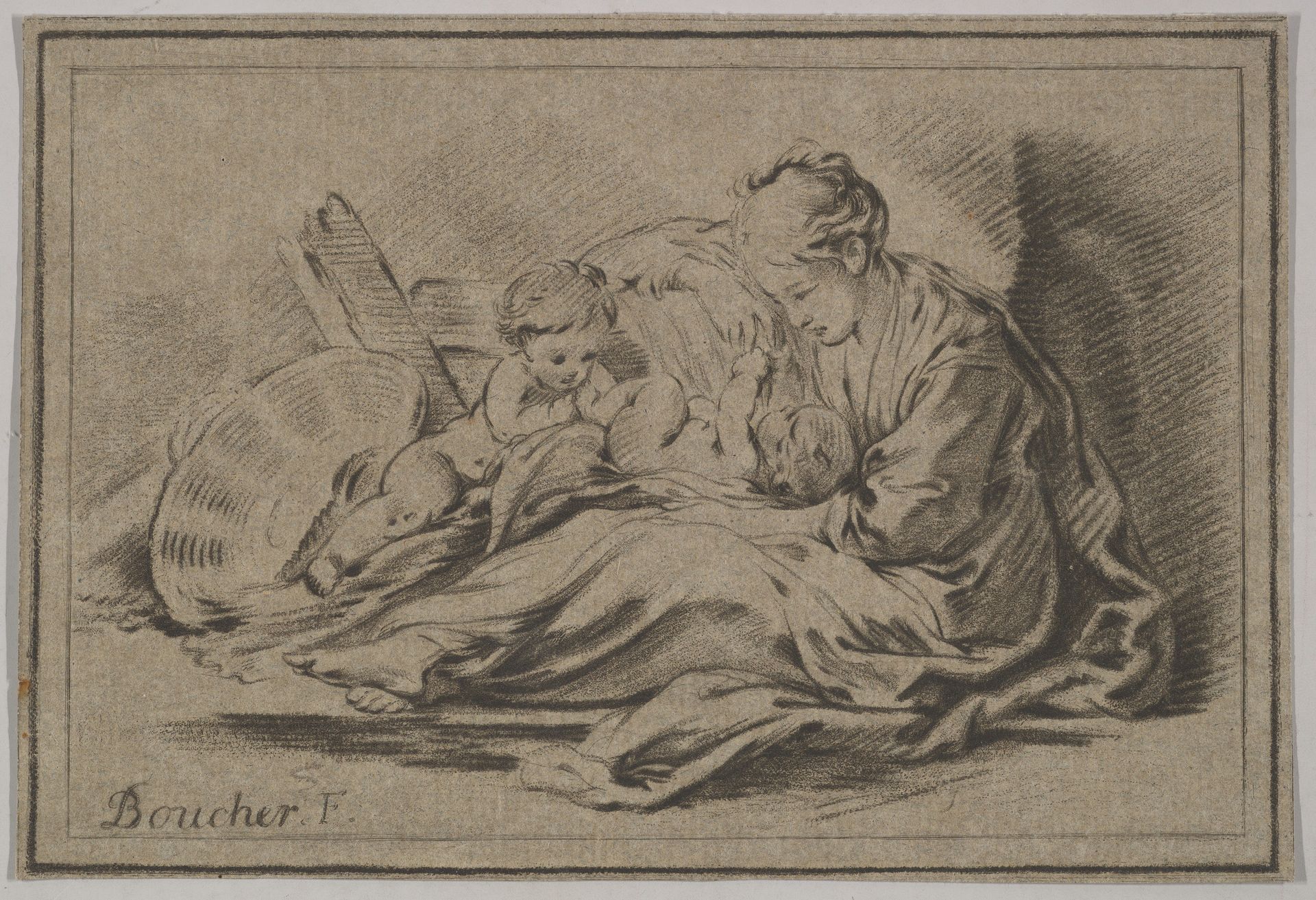
Curator: Upon initial viewing, I see the tenderness here. It is a sketch, unfinished, perhaps, yet radiating profound intimacy. Editor: Yes, I agree. And that immediate warmth speaks to Boucher's skill at capturing sentimental moments, even within the Rococo style known for its extravagance. We’re looking at "Mother with Two Children," a print made sometime between 1729 and 1798. It’s currently held in the collection of the Metropolitan Museum. The drawing depicts a mother cradling an infant while another child sits beside her. Curator: The mother figure here is particularly fascinating when contextualized against broader societal expectations of women during this era. The rise of the bourgeoisie created new roles for women but did not necessarily free them from patriarchal demands. The composition, in turn, represents the idealized image of motherhood. Editor: Interesting that you point out the "idealized." The artist gives us familiar symbols of maternal devotion. The way her body embraces and protects them seems to reflect archetypal Madonna imagery—the eternal mother, nurturing and watchful. Note how the shading concentrates on their forms, bathing them in a spiritual light. Curator: The composition could easily gloss over very real class differences in representations of maternity and women’s labor, the Rococo style often obscuring the reality of women’s work and contribution to society. Do you agree? Editor: A valid critique. It is interesting how even what seems to be a common scene—a mother and children—becomes complex when we realize the context of both motherhood and representations of maternity, especially then. For Boucher, did portraying women’s intimate experience further validate social stereotypes or empower his subjects? Curator: Precisely. Boucher existed in a social paradox himself, in serving elitist commissions while democratizing certain iconographies. Editor: Seeing those blurred boundaries makes us more attuned to today's own visual languages, and maybe allows a deeper engagement with depictions of motherhood—seeing it anew and allowing further artistic interpretation, freed from gender stereotypes. Curator: It makes the historical weight more accessible and human. Thanks for this chat. Editor: And to you. Examining artwork in multiple contexts definitely sheds new light.
Mother with Two Children 1729 - 1798


Artwork details
- Medium
- drawing, print
- Dimensions
- Sheet: 4 15/16 x 7 1/4 in. (12.5 x 18.4 cm)
- Location
- Metropolitan Museum of Art, New York, NY
- Copyright
- Public Domain
Tags
portrait
drawing
figuration
genre-painting
rococo
Comments
No comments
About this artwork
Curator: Upon initial viewing, I see the tenderness here. It is a sketch, unfinished, perhaps, yet radiating profound intimacy. Editor: Yes, I agree. And that immediate warmth speaks to Boucher's skill at capturing sentimental moments, even within the Rococo style known for its extravagance. We’re looking at "Mother with Two Children," a print made sometime between 1729 and 1798. It’s currently held in the collection of the Metropolitan Museum. The drawing depicts a mother cradling an infant while another child sits beside her. Curator: The mother figure here is particularly fascinating when contextualized against broader societal expectations of women during this era. The rise of the bourgeoisie created new roles for women but did not necessarily free them from patriarchal demands. The composition, in turn, represents the idealized image of motherhood. Editor: Interesting that you point out the "idealized." The artist gives us familiar symbols of maternal devotion. The way her body embraces and protects them seems to reflect archetypal Madonna imagery—the eternal mother, nurturing and watchful. Note how the shading concentrates on their forms, bathing them in a spiritual light. Curator: The composition could easily gloss over very real class differences in representations of maternity and women’s labor, the Rococo style often obscuring the reality of women’s work and contribution to society. Do you agree? Editor: A valid critique. It is interesting how even what seems to be a common scene—a mother and children—becomes complex when we realize the context of both motherhood and representations of maternity, especially then. For Boucher, did portraying women’s intimate experience further validate social stereotypes or empower his subjects? Curator: Precisely. Boucher existed in a social paradox himself, in serving elitist commissions while democratizing certain iconographies. Editor: Seeing those blurred boundaries makes us more attuned to today's own visual languages, and maybe allows a deeper engagement with depictions of motherhood—seeing it anew and allowing further artistic interpretation, freed from gender stereotypes. Curator: It makes the historical weight more accessible and human. Thanks for this chat. Editor: And to you. Examining artwork in multiple contexts definitely sheds new light.
Comments
No comments