About this artwork
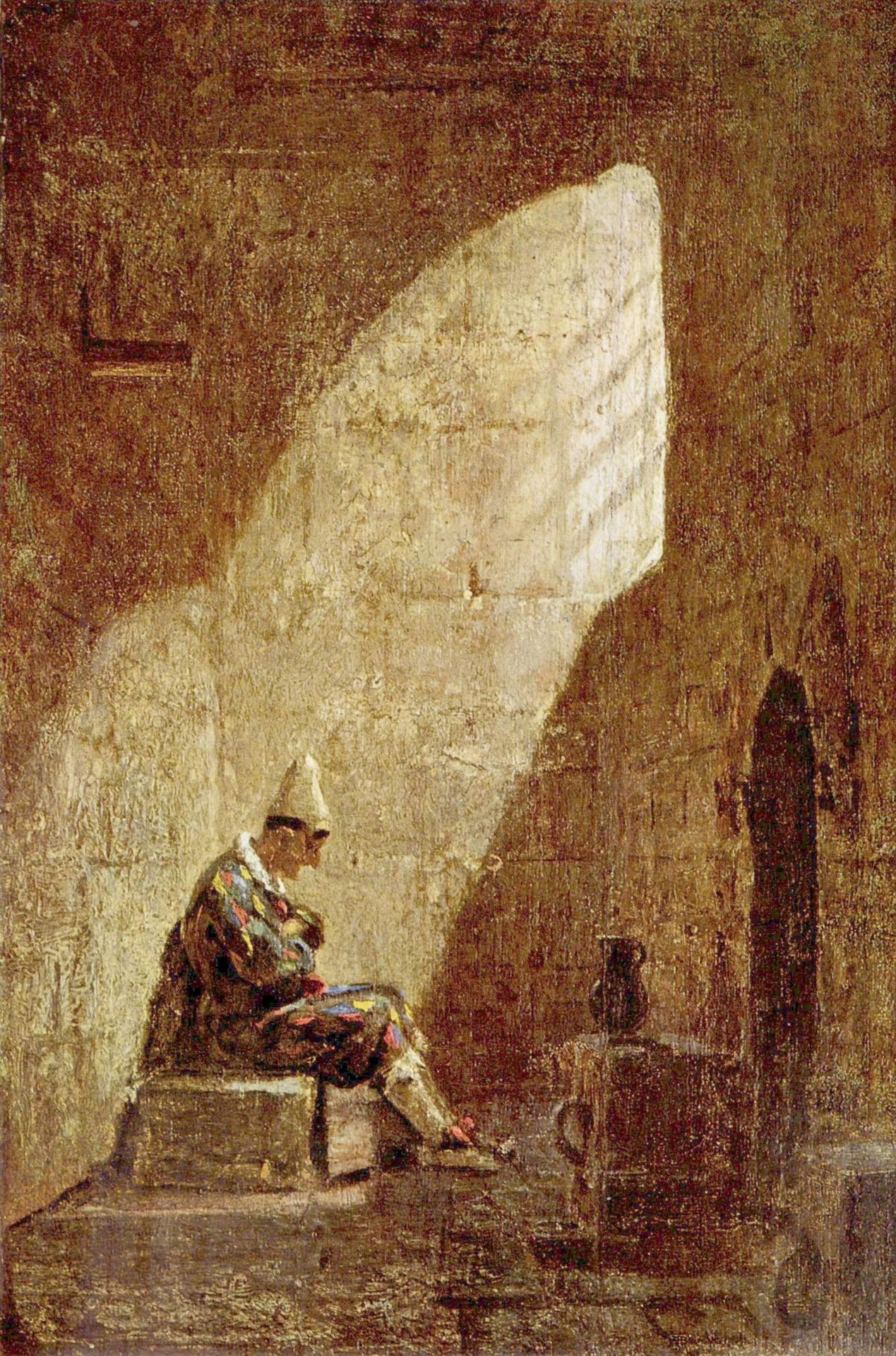
Carl Spitzweg created this oil on canvas, "Ash Wednesday", now hanging in the Staatsgalerie Stuttgart. At first glance, the somber tones and the stark contrast between light and shadow set a mood of reflection and solitude. A lone figure, adorned in a harlequin costume, sits dejectedly in what appears to be a prison cell. The composition is structured by the strong vertical lines of the walls, sharply bisected by a beam of light that serves to isolate the clown. Spitzweg uses this light not merely to illuminate but to create a sense of confinement, emphasizing the harlequin's isolation. Notice how the texture of the walls, rendered with thick impasto, contrasts with the smooth areas of light, enhancing the sense of depth and enclosure. The clown's downcast posture suggests a moment of introspection. The vibrant colors of his costume, juxtaposed against the monochrome background, highlight his emotional state. The use of light and shadow here could be interpreted through a semiotic lens. The cultural codes of mourning and repentance inform our reading of the clown, and invite reflection on the relationship between appearance and reality.
Ash Wednesday 1860

Carl Spitzweg
1808 - 1880Location
Staatsgalerie Stuttgart, Stuttgart, GermanyArtwork details
- Dimensions
- 21 x 14 cm
- Location
- Staatsgalerie Stuttgart, Stuttgart, Germany
- Copyright
- Public domain
Comments
No comments
About this artwork
Carl Spitzweg created this oil on canvas, "Ash Wednesday", now hanging in the Staatsgalerie Stuttgart. At first glance, the somber tones and the stark contrast between light and shadow set a mood of reflection and solitude. A lone figure, adorned in a harlequin costume, sits dejectedly in what appears to be a prison cell. The composition is structured by the strong vertical lines of the walls, sharply bisected by a beam of light that serves to isolate the clown. Spitzweg uses this light not merely to illuminate but to create a sense of confinement, emphasizing the harlequin's isolation. Notice how the texture of the walls, rendered with thick impasto, contrasts with the smooth areas of light, enhancing the sense of depth and enclosure. The clown's downcast posture suggests a moment of introspection. The vibrant colors of his costume, juxtaposed against the monochrome background, highlight his emotional state. The use of light and shadow here could be interpreted through a semiotic lens. The cultural codes of mourning and repentance inform our reading of the clown, and invite reflection on the relationship between appearance and reality.
Comments
No comments