About this artwork
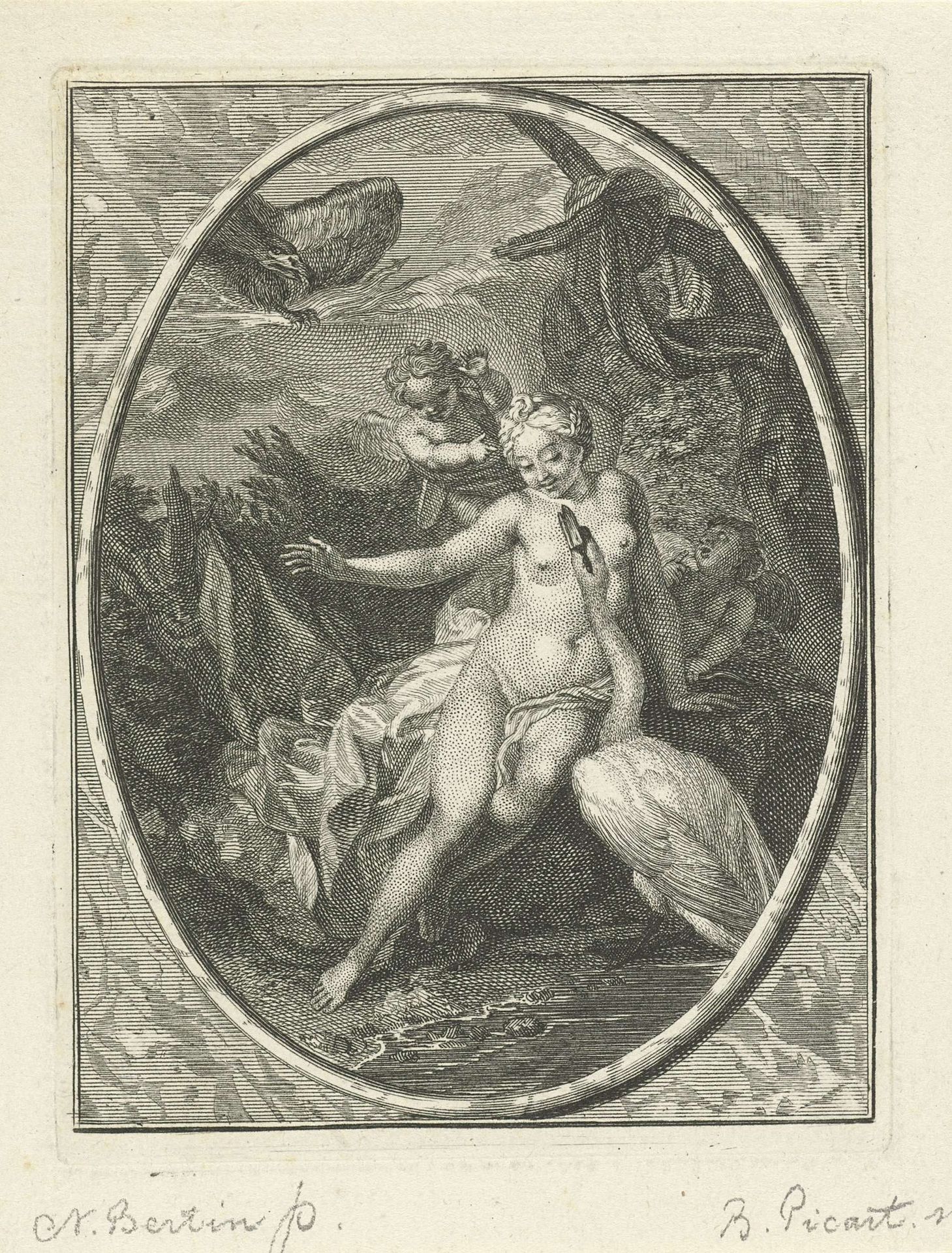
Editor: This is "Leda and the Swan," an engraving by Bernard Picart, made sometime between 1705 and 1733. It has such intricate detail! The texture almost makes it look like a painting. What do you see in this piece from a formalist perspective? Curator: My focus immediately goes to the composition. Notice the oval frame within which the scene unfolds. The figures of Leda and the swan are centrally placed, forming a dynamic diagonal axis that cuts through the frame's static shape. What does that juxtaposition do for you? Editor: It creates a sense of tension. The energy of the figures seems to push against the boundary, like they are trying to break free. The hatching must have taken so much patience! Curator: Precisely! The artist uses cross-hatching to define form and volume. Notice the varying density of lines. Where are they thickest? What effect does that have on the eye? Editor: The hatching seems densest in the darker areas like the foliage behind Leda, making them recede. While the lighter areas, like her skin and the swan’s feathers, pop. The light seems to define their contours. Curator: Exactly! The contrast in tonal values is strategically employed to create a sense of depth and three-dimensionality within a two-dimensional medium. Picart has also included several cherubic figures. They help contribute to the allegorical mood, no? Editor: They do, now that you point it out, though honestly at first I was not sure what to make of their presence! I will have to make more of an effort to decode artworks using formal analysis as a foundation for the underlying ideas. Curator: Indeed. Form is never truly divorced from content, only perceived as such for our own analyses. Seeing is itself an active construction!

Artwork details
- Medium
- engraving
- Dimensions
- height 112 mm, width 86 mm
- Location
- Rijksmuseum
- Copyright
- Rijks Museum: Open Domain
Tags
Comments
Share your thoughts
About this artwork
Editor: This is "Leda and the Swan," an engraving by Bernard Picart, made sometime between 1705 and 1733. It has such intricate detail! The texture almost makes it look like a painting. What do you see in this piece from a formalist perspective? Curator: My focus immediately goes to the composition. Notice the oval frame within which the scene unfolds. The figures of Leda and the swan are centrally placed, forming a dynamic diagonal axis that cuts through the frame's static shape. What does that juxtaposition do for you? Editor: It creates a sense of tension. The energy of the figures seems to push against the boundary, like they are trying to break free. The hatching must have taken so much patience! Curator: Precisely! The artist uses cross-hatching to define form and volume. Notice the varying density of lines. Where are they thickest? What effect does that have on the eye? Editor: The hatching seems densest in the darker areas like the foliage behind Leda, making them recede. While the lighter areas, like her skin and the swan’s feathers, pop. The light seems to define their contours. Curator: Exactly! The contrast in tonal values is strategically employed to create a sense of depth and three-dimensionality within a two-dimensional medium. Picart has also included several cherubic figures. They help contribute to the allegorical mood, no? Editor: They do, now that you point it out, though honestly at first I was not sure what to make of their presence! I will have to make more of an effort to decode artworks using formal analysis as a foundation for the underlying ideas. Curator: Indeed. Form is never truly divorced from content, only perceived as such for our own analyses. Seeing is itself an active construction!
Comments
Share your thoughts