About this artwork
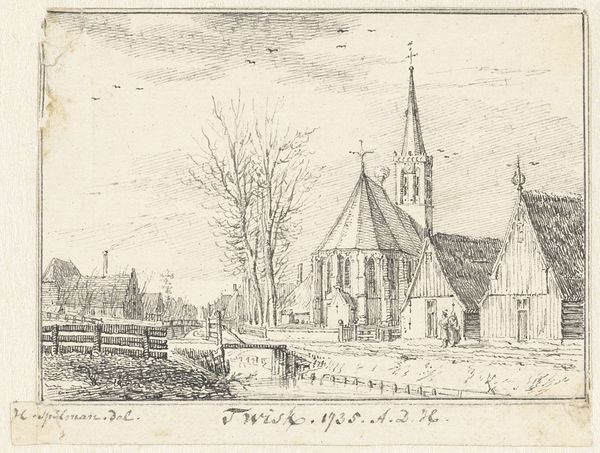
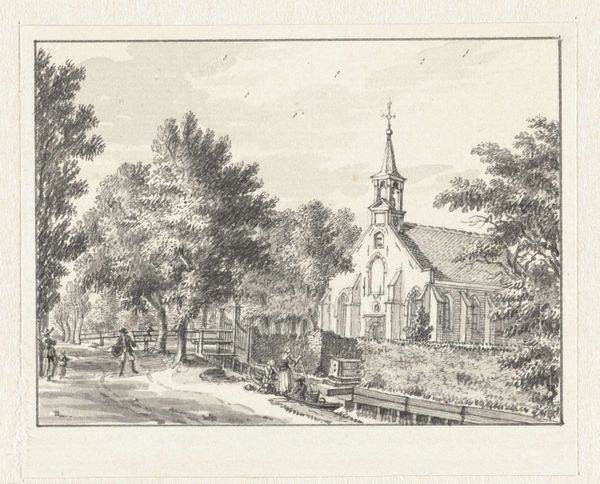
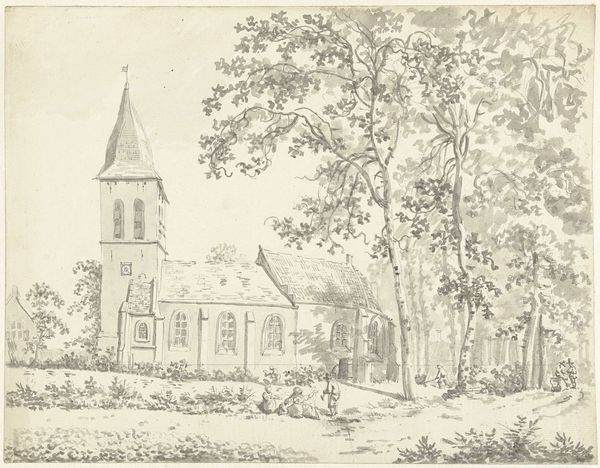
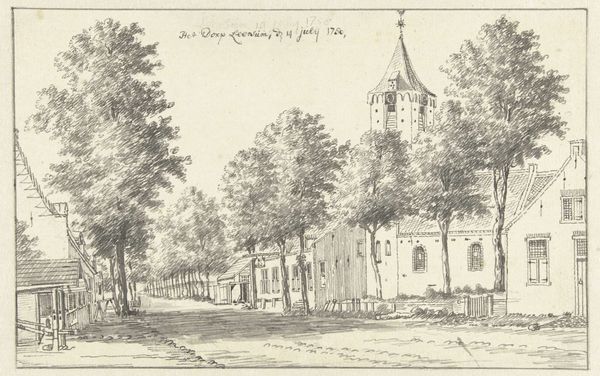
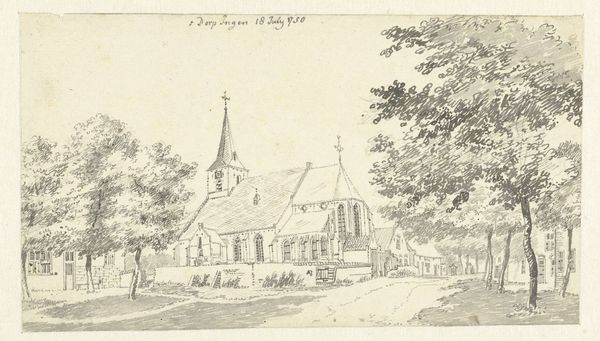
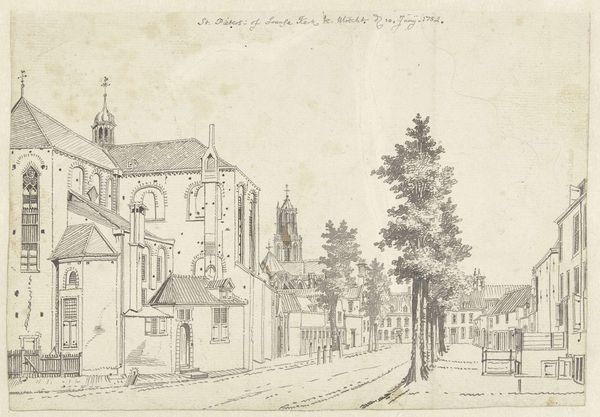
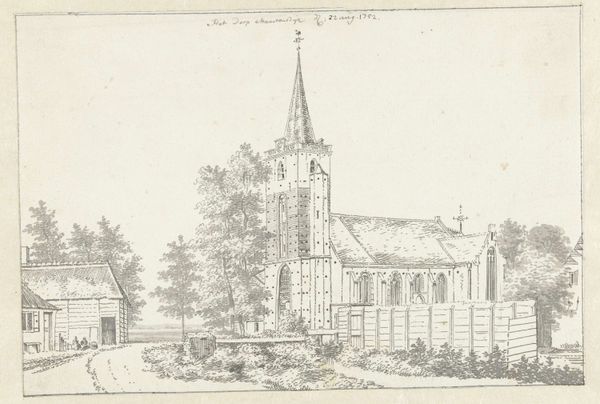
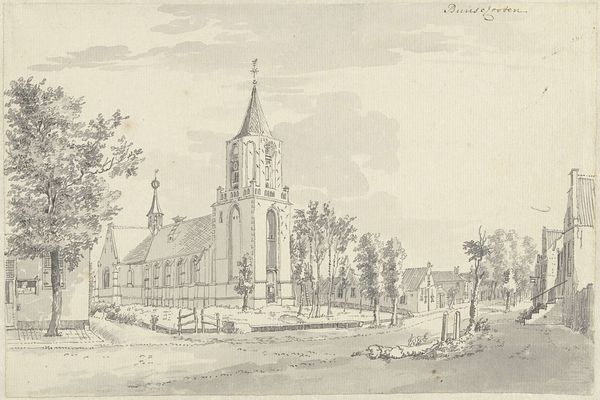
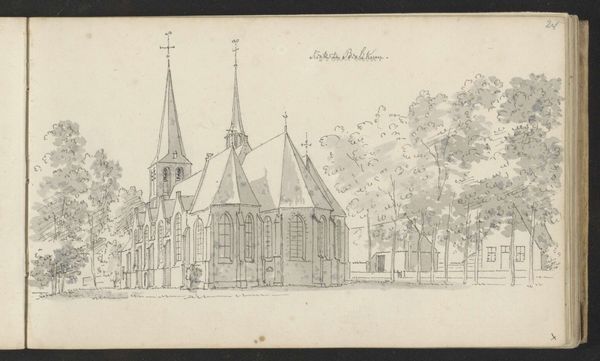
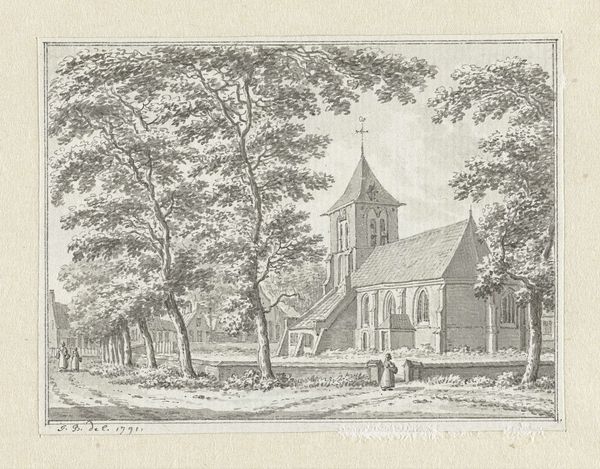
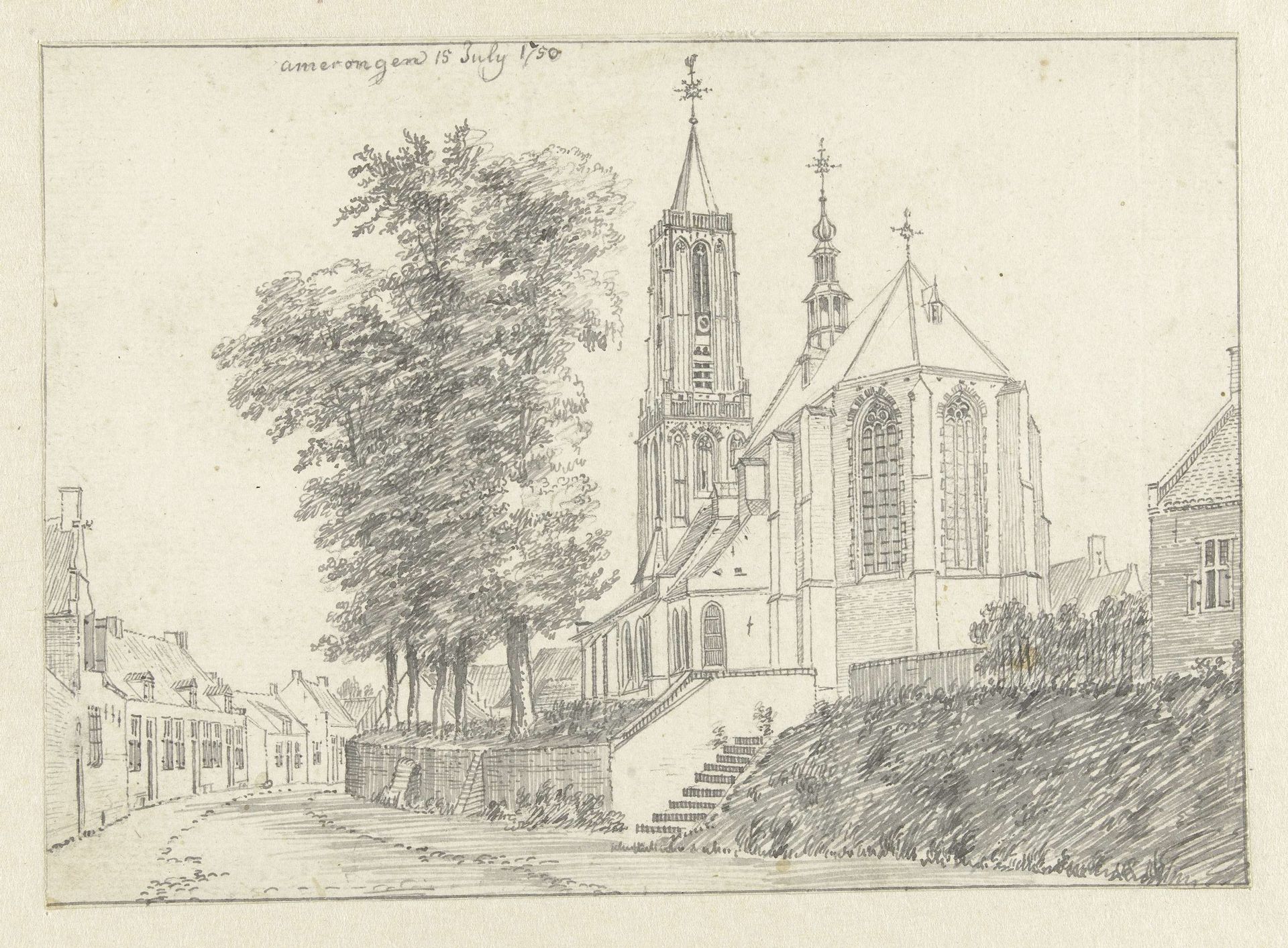
Curator: This pen and pencil drawing, possibly created between 1750 and 1757, is entitled "Gezicht in Amerongen," or "View of Amerongen," attributed to Jan de Beijer. Editor: My first thought? A peaceful Sunday morning. It's quiet, the light is soft, and there's a sense of reverence. I can almost hear the birds chirping and feel the cool air. Curator: Yes, the serenity is striking. De Beijer's approach speaks to a period grappling with ideas of religious authority, civic order, and emerging national identity in the Netherlands. The placement of the church is significant. Editor: Absolutely. It’s not just a church; it’s a silent, steadfast presence, a reminder of something greater. I like how the street seems to lead straight into it, as if life's journey inevitably arrives at that destination. It also seems like a quick study, a memory being captured. Curator: I agree, its documentary style lends the piece some importance. In a society increasingly concerned with accurately mapping its own territory and understanding its history, such a depiction of a specific location holds weight, asserting cultural pride. The attention to detail is striking. Editor: Agreed. Check out how he’s handled the foliage. The textures, all achieved with what looks like the simplest of lines…it’s incredible. It breathes life into the sketch, keeping it from feeling sterile. Curator: Looking through the lens of social history, how do we read the accessibility of the church, both its physical location at the top of those stairs but also the suggestion of it dominating social and religious lives? Is this drawing simply about the aesthetics of the church, or the relationship to power structures? Editor: It is interesting to think about this piece through those lenses, and certainly the institutionalized Church carries complicated social history in Europe. At the same time, on a personal note, my artistic take-away is of the beauty and timelessness of light. I love how simple tools can so powerfully evoke depth, and it reminds me of how much beauty exists right around us, waiting to be sketched, drawn, and felt. Curator: Ultimately, it is how the artist situates himself, both physically and ideologically, relative to the view of Amerongen and how viewers today relate that makes this drawing a culturally revealing piece. Editor: Precisely, I guess this is the everlasting power of art, allowing us all to connect across so many eras and contexts.

Artwork details
- Medium
- drawing, pencil, pen
- Dimensions
- height 143 mm, width 200 mm
- Location
- Rijksmuseum
- Copyright
- Rijks Museum: Open Domain
Tags
drawing
dutch-golden-age
mechanical pen drawing
pen sketch
old engraving style
sketch book
landscape
perspective
personal sketchbook
sketchwork
pen-ink sketch
pencil
pen work
sketchbook drawing
pen
cityscape
storyboard and sketchbook work
realism
Comments
Be the first to share your thoughts about this work.
About this artwork
Curator: This pen and pencil drawing, possibly created between 1750 and 1757, is entitled "Gezicht in Amerongen," or "View of Amerongen," attributed to Jan de Beijer. Editor: My first thought? A peaceful Sunday morning. It's quiet, the light is soft, and there's a sense of reverence. I can almost hear the birds chirping and feel the cool air. Curator: Yes, the serenity is striking. De Beijer's approach speaks to a period grappling with ideas of religious authority, civic order, and emerging national identity in the Netherlands. The placement of the church is significant. Editor: Absolutely. It’s not just a church; it’s a silent, steadfast presence, a reminder of something greater. I like how the street seems to lead straight into it, as if life's journey inevitably arrives at that destination. It also seems like a quick study, a memory being captured. Curator: I agree, its documentary style lends the piece some importance. In a society increasingly concerned with accurately mapping its own territory and understanding its history, such a depiction of a specific location holds weight, asserting cultural pride. The attention to detail is striking. Editor: Agreed. Check out how he’s handled the foliage. The textures, all achieved with what looks like the simplest of lines…it’s incredible. It breathes life into the sketch, keeping it from feeling sterile. Curator: Looking through the lens of social history, how do we read the accessibility of the church, both its physical location at the top of those stairs but also the suggestion of it dominating social and religious lives? Is this drawing simply about the aesthetics of the church, or the relationship to power structures? Editor: It is interesting to think about this piece through those lenses, and certainly the institutionalized Church carries complicated social history in Europe. At the same time, on a personal note, my artistic take-away is of the beauty and timelessness of light. I love how simple tools can so powerfully evoke depth, and it reminds me of how much beauty exists right around us, waiting to be sketched, drawn, and felt. Curator: Ultimately, it is how the artist situates himself, both physically and ideologically, relative to the view of Amerongen and how viewers today relate that makes this drawing a culturally revealing piece. Editor: Precisely, I guess this is the everlasting power of art, allowing us all to connect across so many eras and contexts.
Comments
Be the first to share your thoughts about this work.