About this artwork
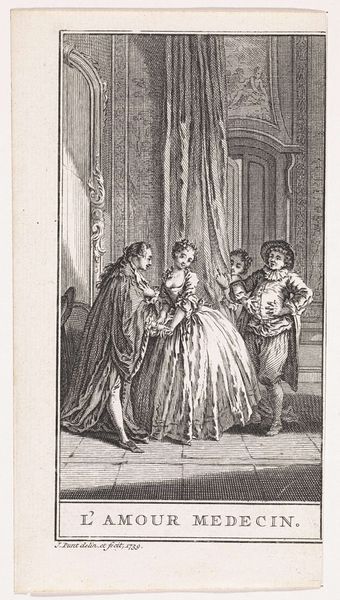
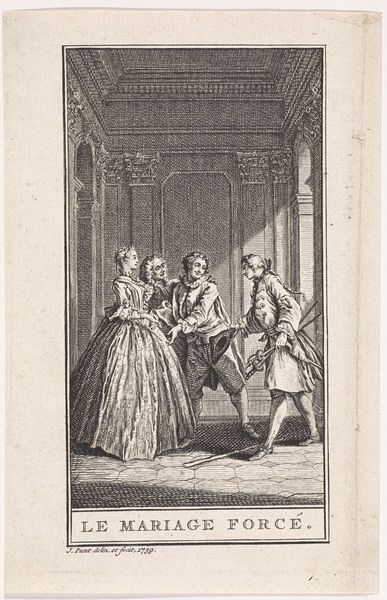
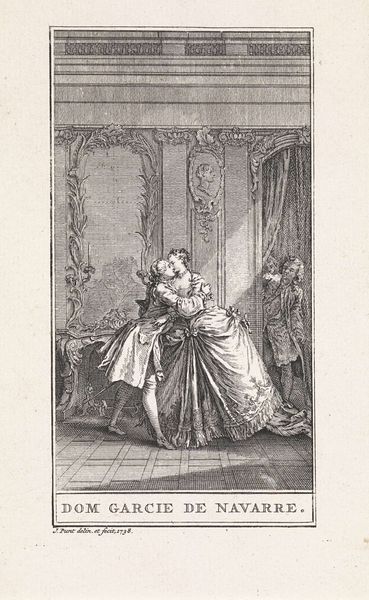
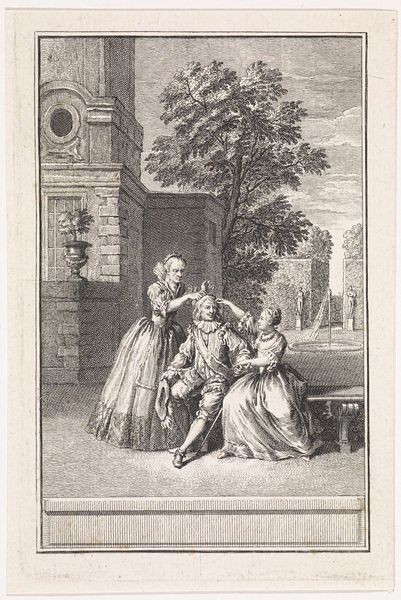
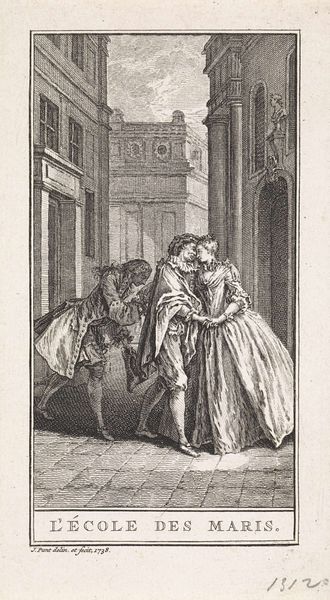
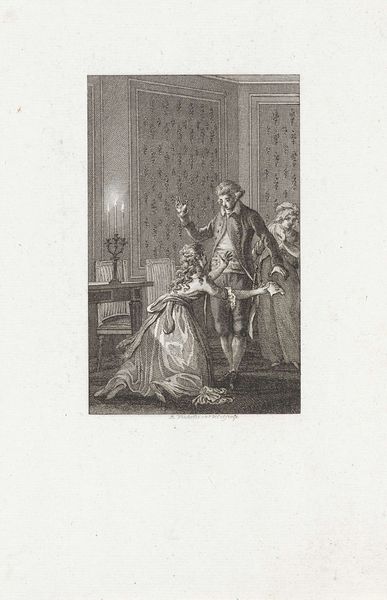
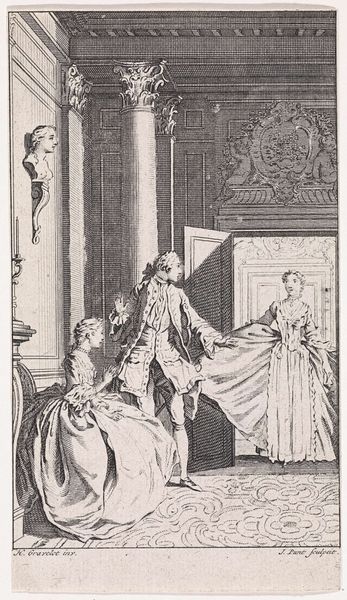
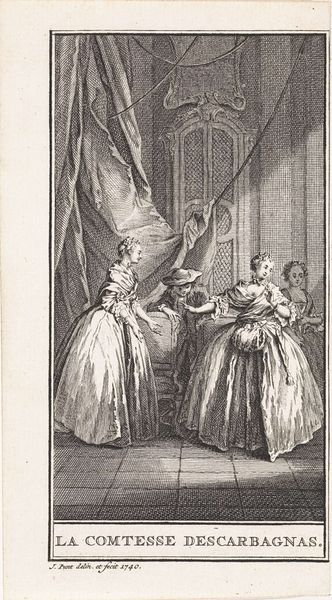
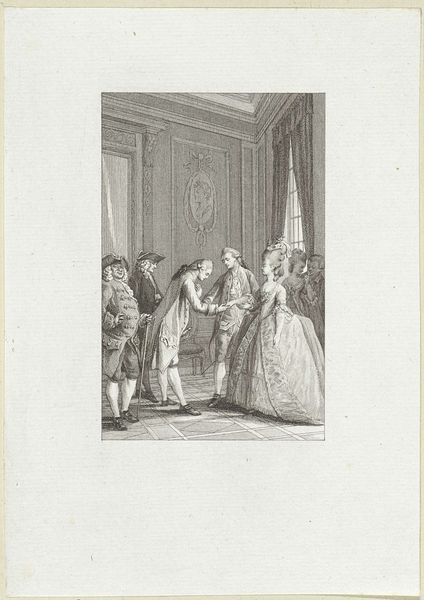
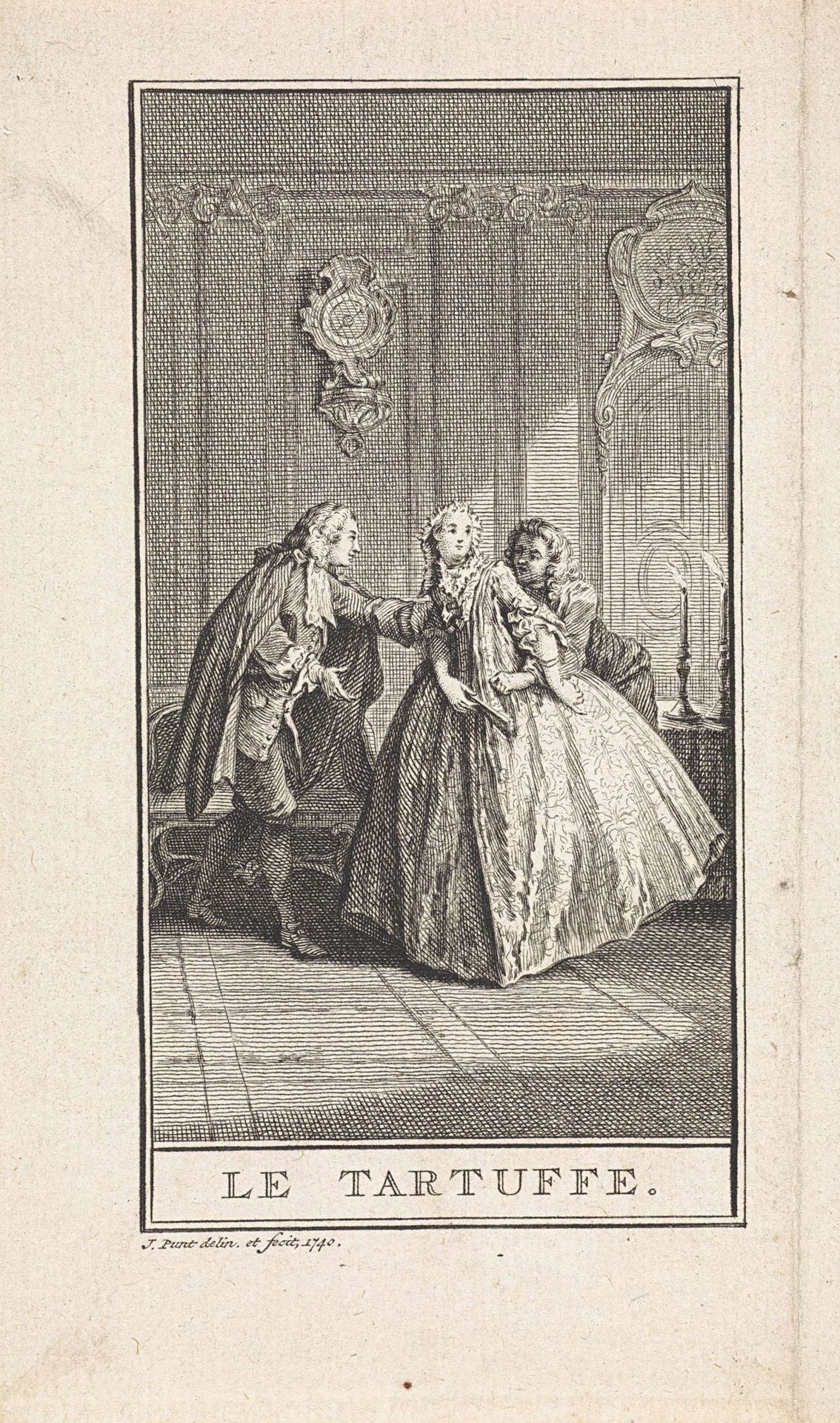
Curator: This print by Jan Punt, created around 1740, is titled "Young Woman Departing." It's an engraving that speaks volumes about societal roles and hidden power dynamics. Editor: My initial feeling is one of quiet desperation. The high contrast lends a dramatic flair to this moment of perceived entrapment. Curator: Entrapment, that's a potent word choice. The woman, dressed in an enormous Baroque gown, is physically restrained, a small fan clutched in her hand almost defensively. Editor: Absolutely, restrained! You see how the man is seizing her arm. There is also the shadow figure of someone sitting on a sofa. Is she caught? Cornered like a frightened animal? It makes one consider what social constraints existed. Curator: The composition cleverly uses interior space to comment on that social control, I think. Look at the baroque decorations and the shadowing that contributes to a sense of depth, while paradoxically the overall staging of the three figures is very compressed. And you might say that her own fashion imprisons her, no? Editor: The gown practically cages her. And the stern, possessive stance of the man, is echoed by the watching shadow of another. Who knows what trap lies beyond that stagey drawing-room interior? Is the picture simply an episode in a play, or a satire of aristocratic manners? Curator: Indeed, its title *'Le Tartuffe'* certainly points towards it as a stage scene, and therefore more likely the latter. It gives us insight into Jan Punt’s political agenda through social satire in art and culture of that era. Editor: So interesting how a seemingly simple image holds so much to interpret. Perhaps its resonance lies in the ongoing conversations around agency, then and now. Curator: It highlights those timeless tensions, doesn’t it? It is a frozen second, which allows us, even now, to reflect on broader societal issues of gender relations, power and even morality.

Artwork details
- Medium
- print, engraving
- Dimensions
- height 146 mm, width 88 mm
- Location
- Rijksmuseum
- Copyright
- Rijks Museum: Open Domain
Tags
portrait
baroque
figuration
line
genre-painting
history-painting
engraving
Comments
No comments
About this artwork
Curator: This print by Jan Punt, created around 1740, is titled "Young Woman Departing." It's an engraving that speaks volumes about societal roles and hidden power dynamics. Editor: My initial feeling is one of quiet desperation. The high contrast lends a dramatic flair to this moment of perceived entrapment. Curator: Entrapment, that's a potent word choice. The woman, dressed in an enormous Baroque gown, is physically restrained, a small fan clutched in her hand almost defensively. Editor: Absolutely, restrained! You see how the man is seizing her arm. There is also the shadow figure of someone sitting on a sofa. Is she caught? Cornered like a frightened animal? It makes one consider what social constraints existed. Curator: The composition cleverly uses interior space to comment on that social control, I think. Look at the baroque decorations and the shadowing that contributes to a sense of depth, while paradoxically the overall staging of the three figures is very compressed. And you might say that her own fashion imprisons her, no? Editor: The gown practically cages her. And the stern, possessive stance of the man, is echoed by the watching shadow of another. Who knows what trap lies beyond that stagey drawing-room interior? Is the picture simply an episode in a play, or a satire of aristocratic manners? Curator: Indeed, its title *'Le Tartuffe'* certainly points towards it as a stage scene, and therefore more likely the latter. It gives us insight into Jan Punt’s political agenda through social satire in art and culture of that era. Editor: So interesting how a seemingly simple image holds so much to interpret. Perhaps its resonance lies in the ongoing conversations around agency, then and now. Curator: It highlights those timeless tensions, doesn’t it? It is a frozen second, which allows us, even now, to reflect on broader societal issues of gender relations, power and even morality.
Comments
No comments