About this artwork
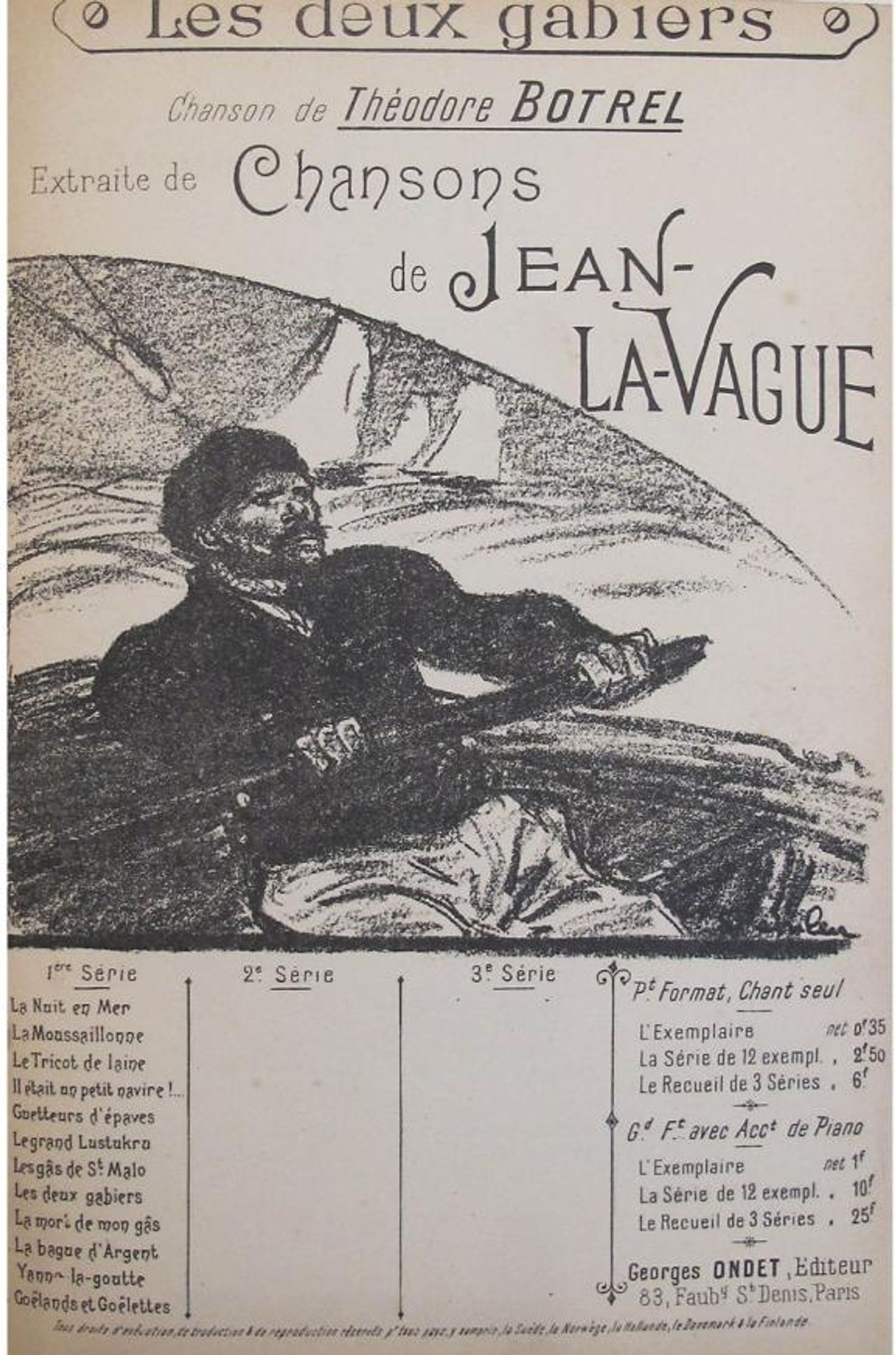
This poster, advertising Théodore Botrel's "Chansons de Jean La Vague", was made by Théophile Alexandre Steinlen. It's a lithograph, a printmaking technique that relies on the artist drawing directly onto a stone or metal plate with a greasy crayon. The poster shows a musician playing his instrument, the dark shading and quick lines creating a sense of movement. The lithographic process, with its directness and capacity for subtle tonal variation, captures the raw energy of the performance, and perhaps, also the labor involved in its making and subsequent distribution of the printed material. Steinlen also worked as an illustrator for journals. So he clearly understood how to create images that could be easily reproduced and widely disseminated. This poster is a testament to the democratizing power of print, making art and music accessible to a broad audience. It blurs the boundaries between fine art and commercial design, revealing the social and economic forces at play in the art world of the time.

Artwork details
- Medium
- drawing, lithograph, print, poster
- Copyright
- Public domain
Tags
portrait
drawing
narrative-art
lithograph
figuration
symbolism
poster
Comments
No comments
About this artwork
This poster, advertising Théodore Botrel's "Chansons de Jean La Vague", was made by Théophile Alexandre Steinlen. It's a lithograph, a printmaking technique that relies on the artist drawing directly onto a stone or metal plate with a greasy crayon. The poster shows a musician playing his instrument, the dark shading and quick lines creating a sense of movement. The lithographic process, with its directness and capacity for subtle tonal variation, captures the raw energy of the performance, and perhaps, also the labor involved in its making and subsequent distribution of the printed material. Steinlen also worked as an illustrator for journals. So he clearly understood how to create images that could be easily reproduced and widely disseminated. This poster is a testament to the democratizing power of print, making art and music accessible to a broad audience. It blurs the boundaries between fine art and commercial design, revealing the social and economic forces at play in the art world of the time.
Comments
No comments