About this artwork
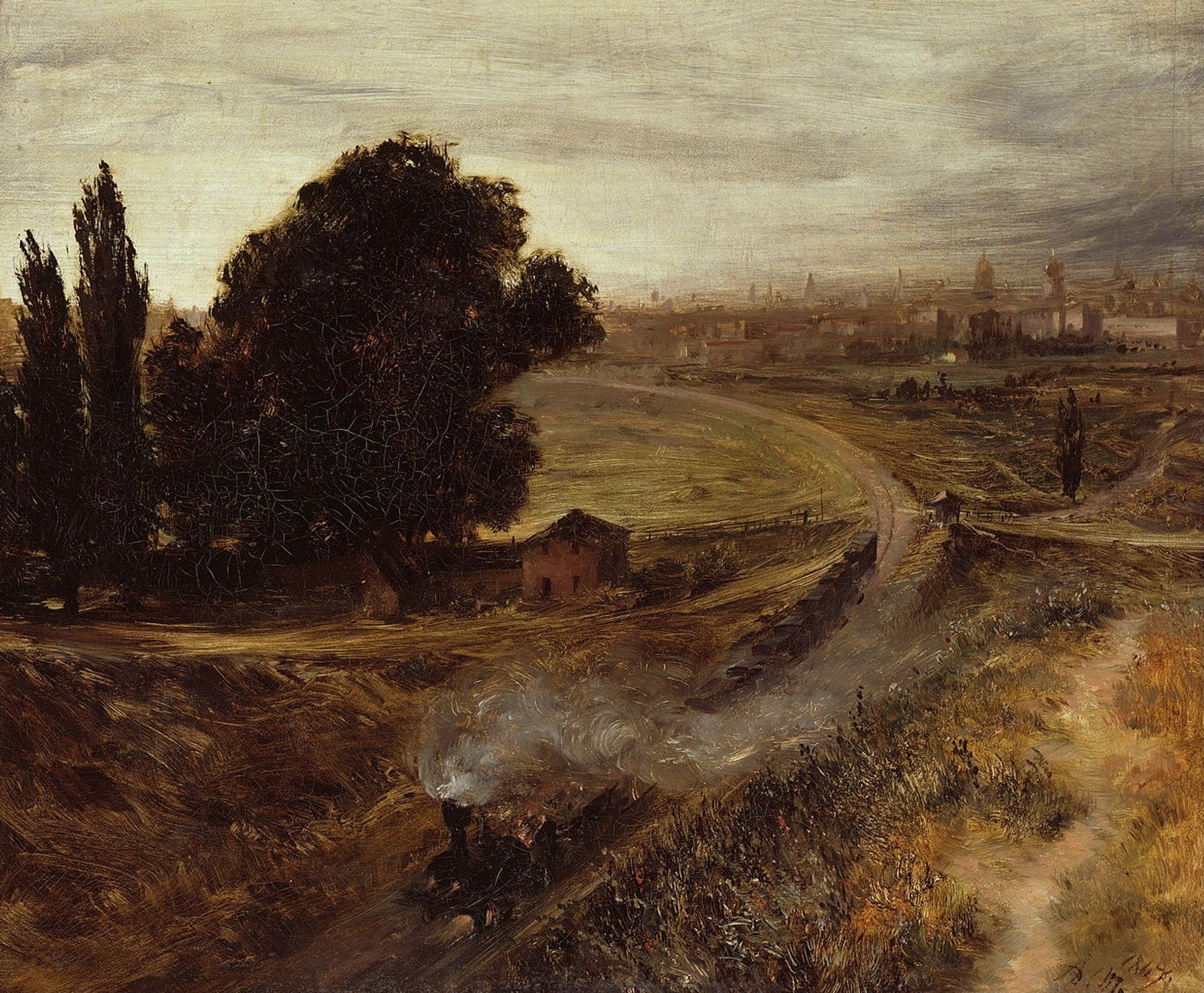
Adolph Menzel’s “The Berlin-Potsdam Railway” captures the dawn of the industrial era through the skilled application of oil paint on canvas. Menzel’s technique, characterized by loose brushwork and a muted palette, mirrors the gritty reality of 19th-century industrialization. The painting’s earth tones, applied with visible strokes, evoke the landscapes altered by industry. The steam engine, a symbol of progress, appears almost as an intrusion upon the natural setting. Consider the labor involved in both the painting and the railway’s creation; Menzel's craft mirrors the skilled traditions that built the nation’s infrastructure. The railway embodies the era’s politics and consumption, connecting resources and markets. By focusing on the material and social context, Menzel challenges the traditional divide between fine art and everyday life, inviting us to reflect on the human cost of progress.
The Berlin-Potsdam Railway
1847

Adolph Menzel
1815 - 1905
Alte Nationalgalerie, Staatliche Museen zu Berlin
Alte Nationalgalerie, Berlin, GermanyArtwork details
- Medium
- painting, oil-paint
- Location
- Alte Nationalgalerie, Berlin, Germany
- Copyright
- Public domain
Tags
painting
oil-paint
landscape
charcoal drawing
oil painting
romanticism
cityscape
genre-painting
charcoal
realism
Comments
Be the first to share your thoughts about this work.
About this artwork
Adolph Menzel’s “The Berlin-Potsdam Railway” captures the dawn of the industrial era through the skilled application of oil paint on canvas. Menzel’s technique, characterized by loose brushwork and a muted palette, mirrors the gritty reality of 19th-century industrialization. The painting’s earth tones, applied with visible strokes, evoke the landscapes altered by industry. The steam engine, a symbol of progress, appears almost as an intrusion upon the natural setting. Consider the labor involved in both the painting and the railway’s creation; Menzel's craft mirrors the skilled traditions that built the nation’s infrastructure. The railway embodies the era’s politics and consumption, connecting resources and markets. By focusing on the material and social context, Menzel challenges the traditional divide between fine art and everyday life, inviting us to reflect on the human cost of progress.
Comments
Be the first to share your thoughts about this work.