About this artwork
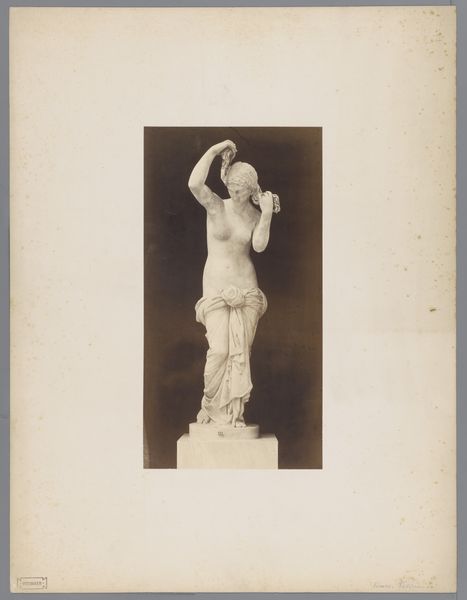
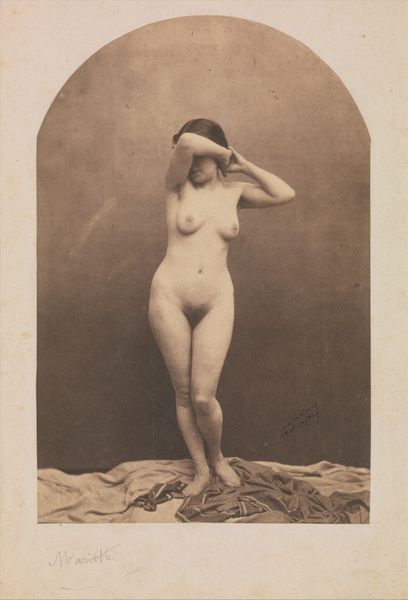
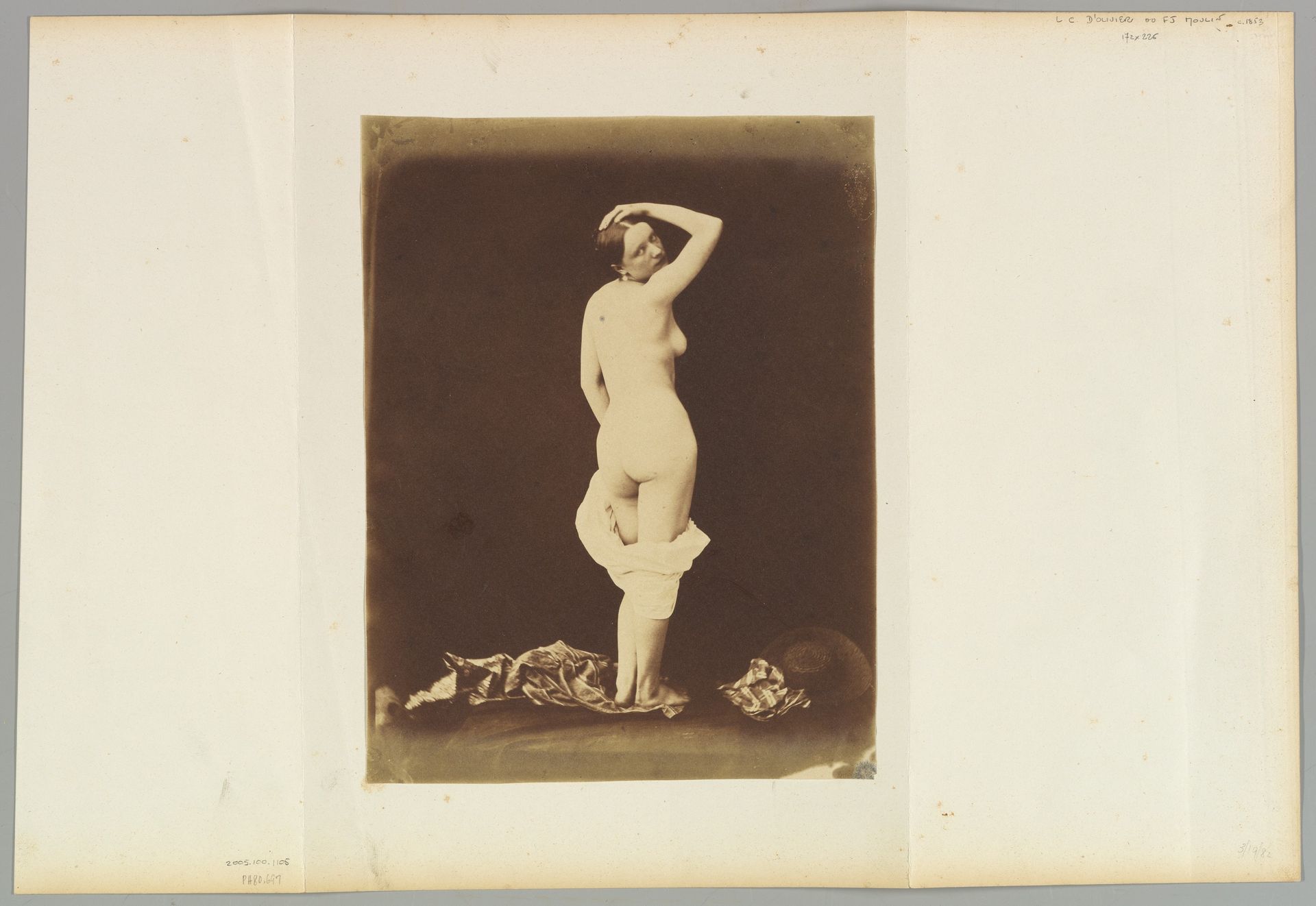
This is Félix-Jacques-Antoine Moulin’s photograph, titled "Nude," its date unknown. Its sepia tones lend a classical feel, reminiscent of academic figure studies. But the photograph's composition, with its juxtaposition of light and shadow, destabilizes traditional notions of beauty and ideal form. The figure is set against a dark background, her skin luminous, almost sculpted by the light. Her pose is self-conscious, drawing attention to her partial disrobing. Her partially removed clothing and the skull at her feet introduce a symbolic language that evokes themes of mortality and transience. Moulin here engages with the semiotics of the nude in art history, yet, the photographic medium introduces a new layer of realism that challenges idealized representations. The image then becomes not just about the female form but also a commentary on representation itself. The contrast of the softness of the skin and the harsh reality of death invites us to reflect on the complex interplay between beauty, decay, and representation within the photographic frame.
Nude
1848 - 1852

Félix-Jacques-Antoine Moulin
1800 - 1875
The Metropolitan Museum of Art
Metropolitan Museum of Art, New York, NYArtwork details
- Medium
- photography, albumen-print
- Dimensions
- Image: 8 13/16 × 6 3/4 in. (22.4 × 17.2 cm) Mount: 11 5/8 × 8 1/16 in. (29.6 × 20.5 cm)
- Location
- Metropolitan Museum of Art, New York, NY
- Copyright
- Public Domain
Tags
Comments
Share your thoughts
About this artwork
This is Félix-Jacques-Antoine Moulin’s photograph, titled "Nude," its date unknown. Its sepia tones lend a classical feel, reminiscent of academic figure studies. But the photograph's composition, with its juxtaposition of light and shadow, destabilizes traditional notions of beauty and ideal form. The figure is set against a dark background, her skin luminous, almost sculpted by the light. Her pose is self-conscious, drawing attention to her partial disrobing. Her partially removed clothing and the skull at her feet introduce a symbolic language that evokes themes of mortality and transience. Moulin here engages with the semiotics of the nude in art history, yet, the photographic medium introduces a new layer of realism that challenges idealized representations. The image then becomes not just about the female form but also a commentary on representation itself. The contrast of the softness of the skin and the harsh reality of death invites us to reflect on the complex interplay between beauty, decay, and representation within the photographic frame.
Comments
Share your thoughts