About this artwork
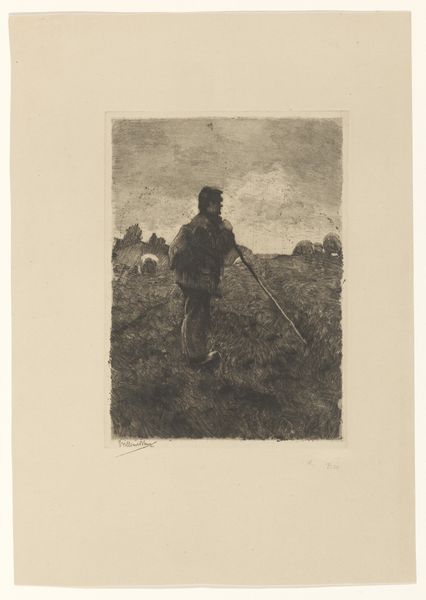
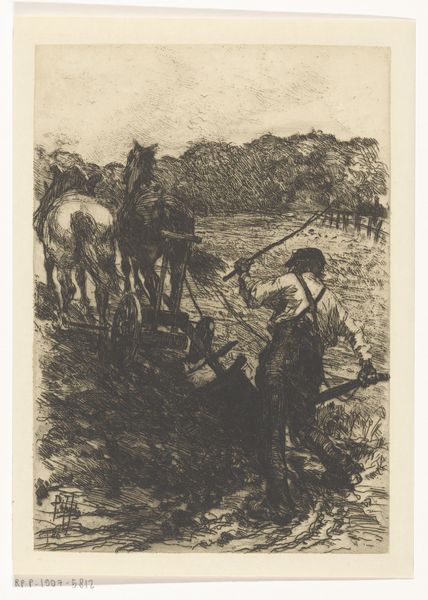
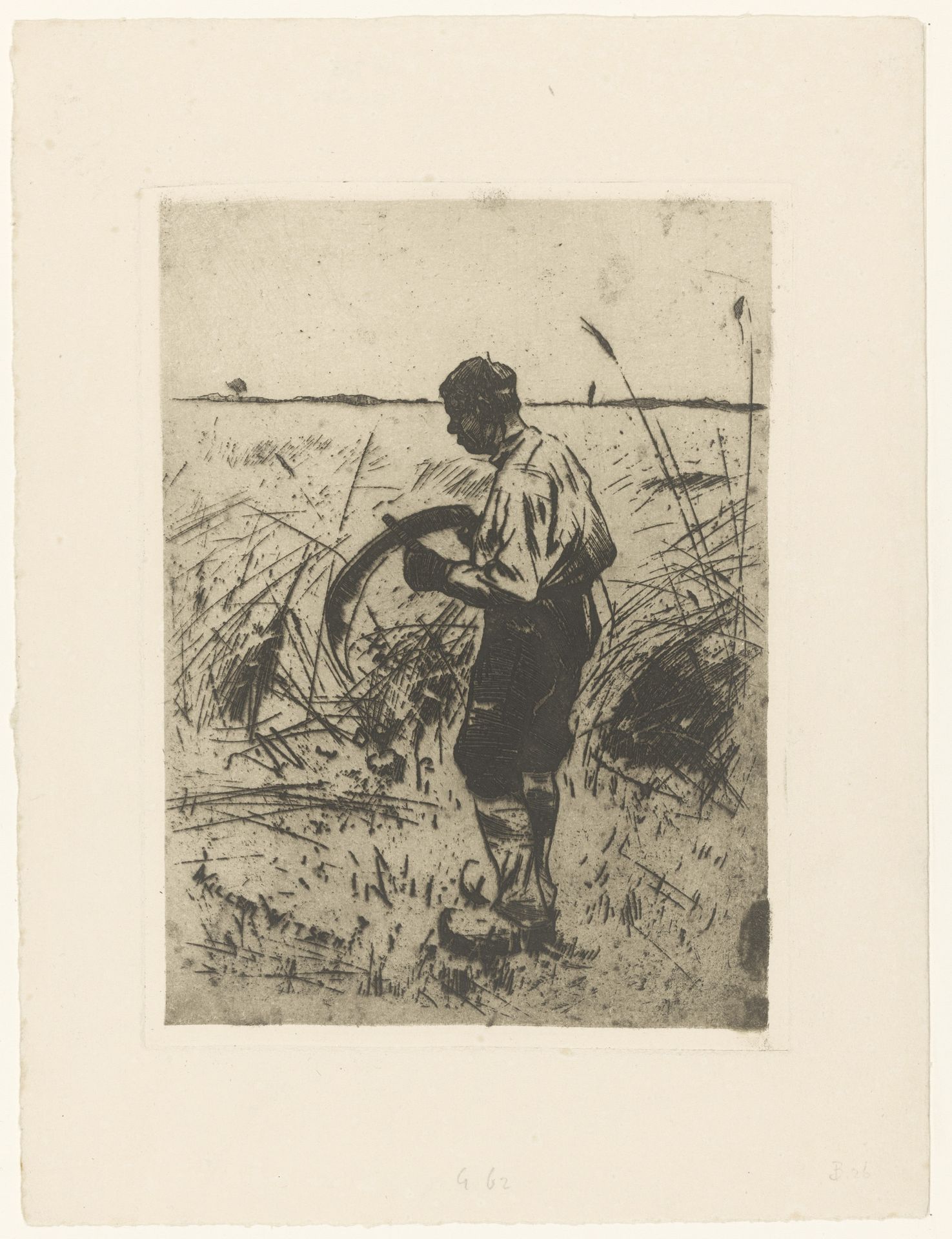
Curator: What a powerful image, the man and his scythe, standing in the fields... The Rijksmuseum holds this etching by Willem Witsen, dating back to approximately 1886, titled 'Boer die zijn zeis wet', which translates to 'Farmer Sharpening His Scythe'. Editor: My first thought? Quiet determination. The monochrome really amplifies the focus, doesn’t it? All that open land and then this concentrated figure... it feels weighted somehow. Curator: Absolutely. Witsen, entrenched in the art world of his time, often focused on such un-heroic figures. Think about how Millet was celebrated, depicting rural laborers... it became fashionable to some extent. Witsen approaches his farmer with that same earnest realism. He's part of the Dutch revival of etching. Editor: The lack of sentimentality really strikes me. He isn’t romanticized; you can almost feel the grindstone grit, hear that shiversome scrape, you know? The scythe’s a dark crescent hovering... not aggressive, but ever-present. Curator: True. Witsen captures the unvarnished reality of agricultural labour in that period. The piece is a great representation of that shift towards representing the everyday as holding beauty and artistic merit. Look at how that fits with contemporaneous social movements of the era, particularly in the Netherlands and France! It became an incredibly important statement. Editor: And the economy of line... it feels modern in its starkness, wouldn’t you agree? It seems to suggest that, while physically taxing, this is an almost meditative task: this daily labour, life and death all tied to this simple movement in nature. Curator: Indeed! Its simple yet deeply compelling atmosphere, reflective of its era, continues to hold its own when looking at how the Realist movement influenced later styles! Thanks for pointing all that out. Editor: Always! I like to imagine Witsen out there with his plate and needle, capturing this individual moment in time. Thanks for the rich insights, you made me see more layers within the sharp lines of this picture!

Artwork details
- Medium
- drawing, print, etching, paper
- Dimensions
- height 242 mm, width 180 mm
- Location
- Rijksmuseum
- Copyright
- Rijks Museum: Open Domain
Tags
drawing
dutch-golden-age
impressionism
etching
landscape
figuration
paper
genre-painting
realism
Comments
No comments
About this artwork
Curator: What a powerful image, the man and his scythe, standing in the fields... The Rijksmuseum holds this etching by Willem Witsen, dating back to approximately 1886, titled 'Boer die zijn zeis wet', which translates to 'Farmer Sharpening His Scythe'. Editor: My first thought? Quiet determination. The monochrome really amplifies the focus, doesn’t it? All that open land and then this concentrated figure... it feels weighted somehow. Curator: Absolutely. Witsen, entrenched in the art world of his time, often focused on such un-heroic figures. Think about how Millet was celebrated, depicting rural laborers... it became fashionable to some extent. Witsen approaches his farmer with that same earnest realism. He's part of the Dutch revival of etching. Editor: The lack of sentimentality really strikes me. He isn’t romanticized; you can almost feel the grindstone grit, hear that shiversome scrape, you know? The scythe’s a dark crescent hovering... not aggressive, but ever-present. Curator: True. Witsen captures the unvarnished reality of agricultural labour in that period. The piece is a great representation of that shift towards representing the everyday as holding beauty and artistic merit. Look at how that fits with contemporaneous social movements of the era, particularly in the Netherlands and France! It became an incredibly important statement. Editor: And the economy of line... it feels modern in its starkness, wouldn’t you agree? It seems to suggest that, while physically taxing, this is an almost meditative task: this daily labour, life and death all tied to this simple movement in nature. Curator: Indeed! Its simple yet deeply compelling atmosphere, reflective of its era, continues to hold its own when looking at how the Realist movement influenced later styles! Thanks for pointing all that out. Editor: Always! I like to imagine Witsen out there with his plate and needle, capturing this individual moment in time. Thanks for the rich insights, you made me see more layers within the sharp lines of this picture!
Comments
No comments