About this artwork
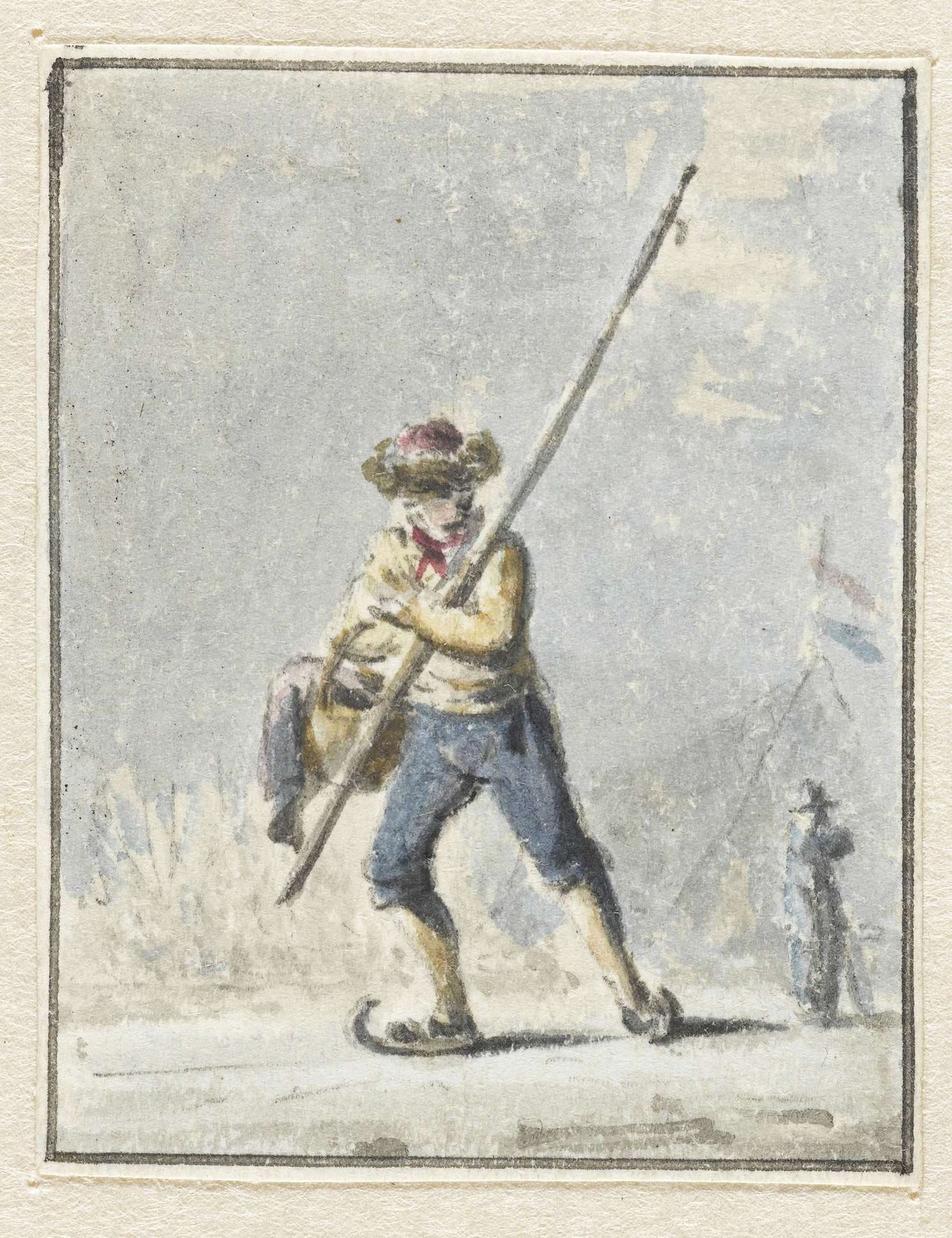
Editor: This is Pieter Bartholomeusz. Barbiers’ “Schaatsenrijder,” made with watercolor sometime between 1782 and 1837. It feels like a quick snapshot of everyday life. What do you see in this piece, looking beyond just the skating? Curator: The most striking feature is the almost pastoral idealization of a commoner. The skater, while simply dressed, carries himself with a certain dignity. He’s imbued with symbolic weight through his stance, almost like a saint carrying a staff, leading the eye upwards to a brighter, hopeful sky. Note the Dutch flag in the background—it subtly suggests national pride intertwined with everyday life. How do you interpret that? Editor: I guess I see it as a claim on winter joy. The flag, positioned just behind the figure, says this enjoyment is intrinsically Dutch. Does this romanticize Dutch culture through a rather humble scene? Curator: Precisely. Barbiers uses the symbol of winter—often associated with hardship—and reframes it. Instead of cold austerity, he finds an opportunity to portray joy and community, a shared experience of nationhood even amongst ordinary folk. It subtly elevates the mundane, almost sacramental in its portrayal. Do you find a psychological aspect to that elevation? Editor: That’s interesting... By framing the everyday with such cultural importance, it encourages a collective, almost nostalgic memory of simpler times and shared values. It's a way of building cultural continuity. Curator: Indeed, Barbiers encapsulates that idea. A simple winter scene becomes a vessel for broader cultural and national identity, showing how powerful symbols in art can evoke emotional responses and reaffirm shared heritage. Editor: I never would have noticed all of that on my own. I’ll definitely look at these everyday scenes differently going forward.

Artwork details
- Medium
- watercolor
- Dimensions
- height 51 mm, width 40 mm
- Location
- Rijksmuseum
- Copyright
- Rijks Museum: Open Domain
Tags
landscape
figuration
watercolor
romanticism
genre-painting
Comments
No comments
About this artwork
Editor: This is Pieter Bartholomeusz. Barbiers’ “Schaatsenrijder,” made with watercolor sometime between 1782 and 1837. It feels like a quick snapshot of everyday life. What do you see in this piece, looking beyond just the skating? Curator: The most striking feature is the almost pastoral idealization of a commoner. The skater, while simply dressed, carries himself with a certain dignity. He’s imbued with symbolic weight through his stance, almost like a saint carrying a staff, leading the eye upwards to a brighter, hopeful sky. Note the Dutch flag in the background—it subtly suggests national pride intertwined with everyday life. How do you interpret that? Editor: I guess I see it as a claim on winter joy. The flag, positioned just behind the figure, says this enjoyment is intrinsically Dutch. Does this romanticize Dutch culture through a rather humble scene? Curator: Precisely. Barbiers uses the symbol of winter—often associated with hardship—and reframes it. Instead of cold austerity, he finds an opportunity to portray joy and community, a shared experience of nationhood even amongst ordinary folk. It subtly elevates the mundane, almost sacramental in its portrayal. Do you find a psychological aspect to that elevation? Editor: That’s interesting... By framing the everyday with such cultural importance, it encourages a collective, almost nostalgic memory of simpler times and shared values. It's a way of building cultural continuity. Curator: Indeed, Barbiers encapsulates that idea. A simple winter scene becomes a vessel for broader cultural and national identity, showing how powerful symbols in art can evoke emotional responses and reaffirm shared heritage. Editor: I never would have noticed all of that on my own. I’ll definitely look at these everyday scenes differently going forward.
Comments
No comments