drawing, ink
#
drawing
#
landscape
#
fantasy-art
#
ink
#
surrealism
#
surrealism
Copyright: Public domain
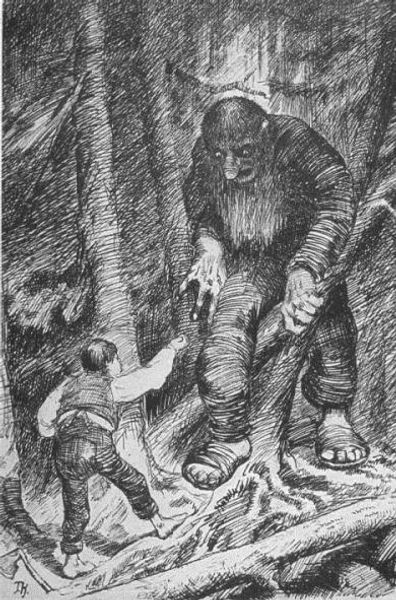
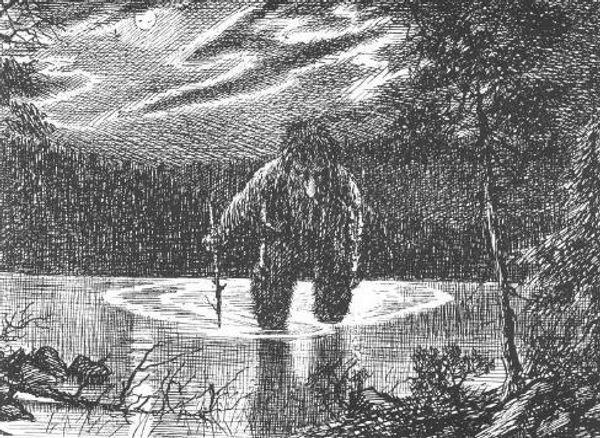
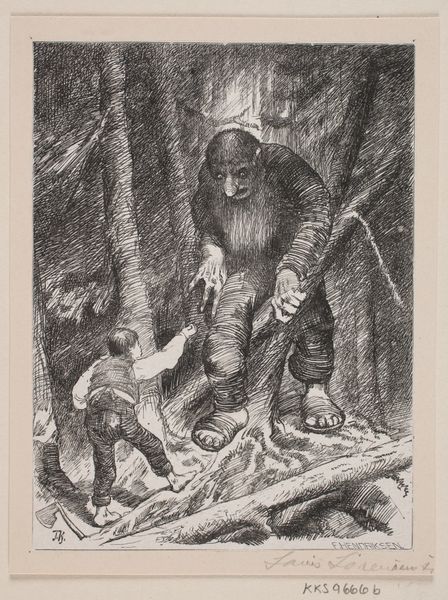
Curator: This is a drawing entitled "Hustrollet Vaart," a fantasy landscape crafted in ink by Theodor Severin Kittelsen. It feels like a page ripped from a nightmare, doesn’t it? Editor: It does, but in a compelling way. The sheer mass of that central figure – a troll, I presume? – looming out of the dense forest is visually striking, particularly in the dramatic, stark tonality of ink. The artist also paid attention to the picture frame. Why the decorative frame on all four sides of the work? Curator: I agree. Let’s situate the figure in Kittelsen's broader body of work. He’s deeply invested in Norwegian folklore and national identity, crafting imagery imbued with the fears, hopes, and anxieties of his time. The troll, a common figure in Scandinavian folklore, is often a stand-in for societal anxieties regarding wilderness versus civilization, perhaps? Editor: That rings true. Consider how the troll is positioned. He emerges, literally framed, by the very wilderness you describe. And within that frame is the luminous circle above the troll, suggestive of folklore traditions associated with the moon’s powers to invoke transformative states and conjure encounters in the nocturnal sphere. The frame calls attention to the symbolism in folklore. Curator: Yes! And the artist is inking what emerges from within. Furthermore, think about the era this work comes from. We can't divorce this imagery from broader anxieties around industrialization, nationalism, and what was perceived as the encroaching modern world’s impact on traditional ways of life. I think there may be nostalgia that connects to this symbolism. Editor: Certainly. These sorts of primordial or grotesque creatures have functioned for centuries to represent our cultural shadow-selves. Here, the inky depths both obscure and reveal a timeless part of the Norwegian cultural memory – or perhaps a fear for cultural erasure. Curator: Exactly. The fear is part of the historical reality in art. It seems to me this ink work suggests that within the frame of culture is a continuous re-framing of culture and how we should act with an appropriate gaze. What has this encounter prompted in you? Editor: It’s stirred a feeling of rediscovering a dark fairy tale I had long forgotten. I'm leaving with a greater awareness of folklore's enduring ability to articulate deep, often unspoken anxieties that echo through generations. What about you? Curator: I’m left contemplating the social contract between ourselves and the “wild” places we occupy. Kittelsen challenges us to confront our complicity in environmental narratives.
Comments
No comments
Be the first to comment and join the conversation on the ultimate creative platform.
 Collect
 React
React Comment
More like this