About this artwork
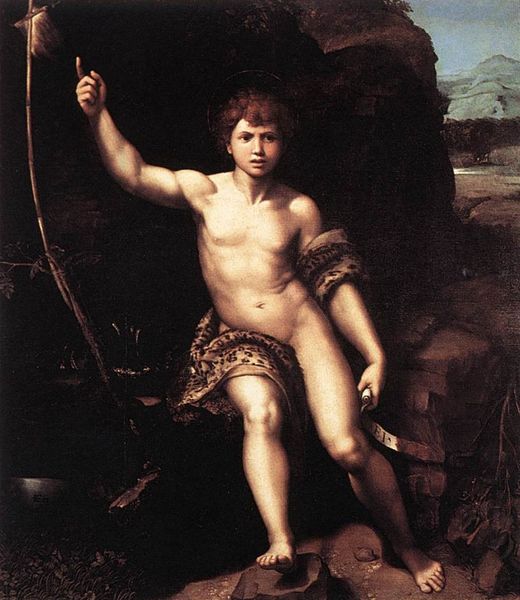
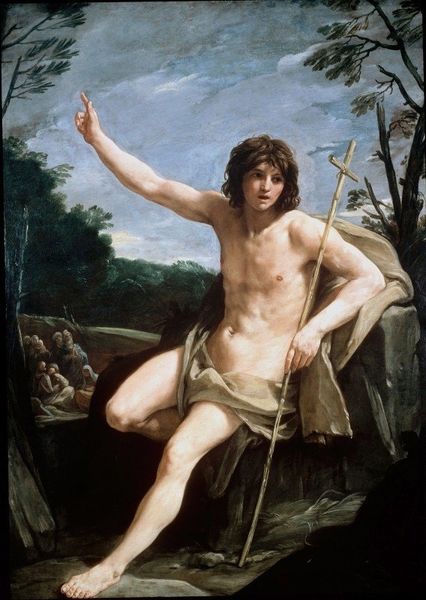
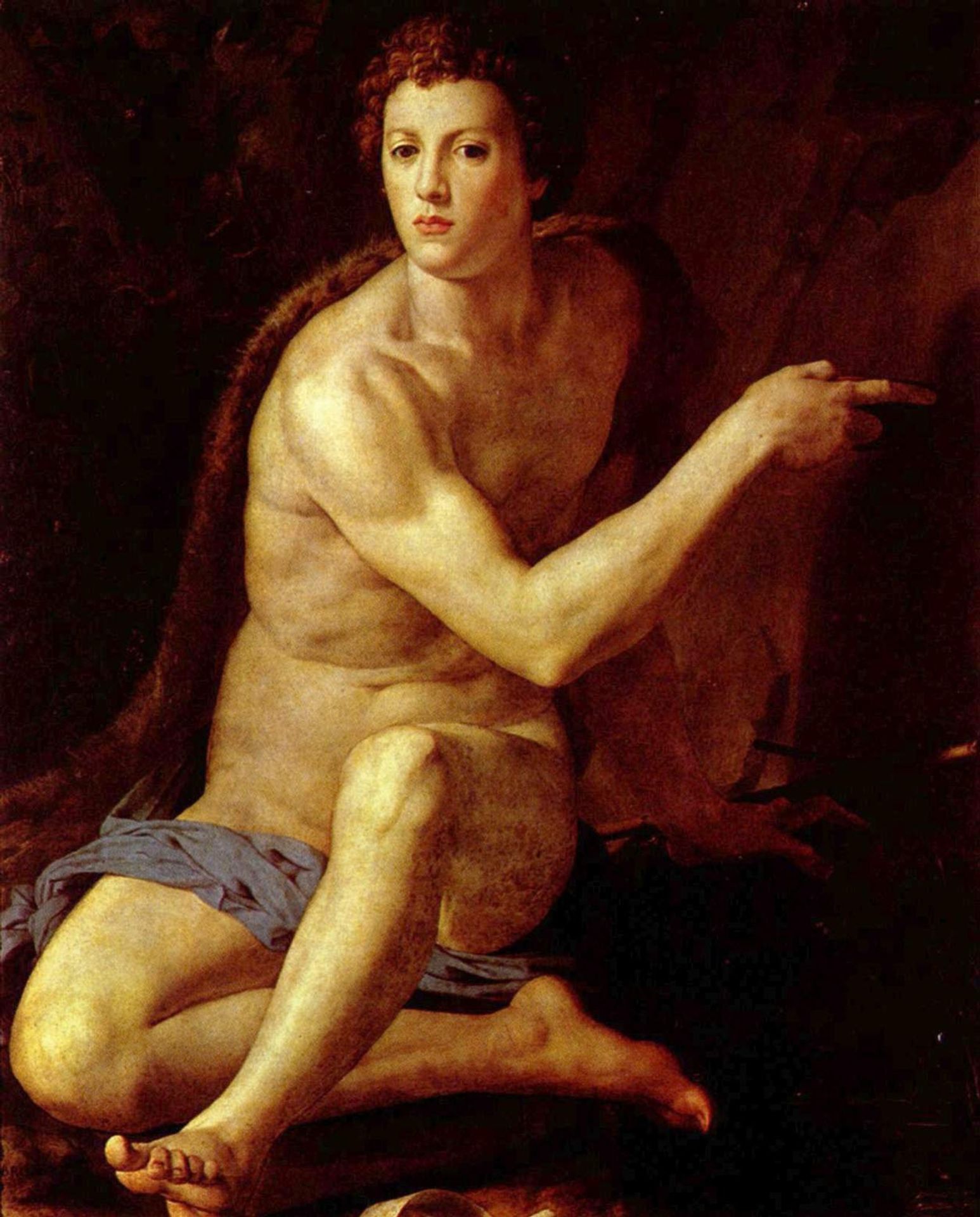
Curator: Agnolo Bronzino’s *Saint John the Baptist*, created in 1553, currently resides in the Borghese Gallery in Rome. It’s quite an imposing figure, wouldn’t you agree? Editor: He's certainly commanding attention. My immediate reaction is one of surprise, really—the muscularity and direct gaze clash with the expected ascetic image of John the Baptist. Almost like a Renaissance bodybuilder playing dress-up. Curator: That’s an interesting take! It showcases Bronzino’s Mannerist style; there's a sense of artificiality, isn’t there? Look at the smooth, almost porcelain skin, the deliberate pose. It's all carefully constructed, not necessarily mirroring reality. It strikes me that even in devotion there's the artifice. Editor: Absolutely, it's manufactured grace. And that intense chiaroscuro! Observe how Bronzino crafts a hyperreal, fleshy John using layers of oil paint. It's not just about spiritual expression; it’s a demonstration of skill and, crucially, material mastery. One must question who financed this canvas and the artist, Bronzino, himself! Was that skill and craftsmanship made for patrons? Or devotion? Or both? Curator: Both, perhaps, intertwined inextricably! As a court painter, Bronzino worked for the Medici; this sensuality hints at the opulence of the court, certainly. Editor: And, let’s not forget that those pigments, that canvas – all those materials required a complex economy and workforce! I find the interplay between labor and devotion almost dizzying, when considered today. Curator: It almost pulls us back to that earthly element which sits counter to the divine one—to experience and maybe reconcile that push-and-pull is certainly an interesting way to reflect. So, thanks, that was interesting, that we can look at materials used to craft something divine in its subject in such different ways. Editor: Yes, revealing the mechanics underneath an icon—always a pleasure.

Artwork details
- Medium
- painting, oil-paint
- Location
- Borghese Gallery, Rome, Italy
- Copyright
- Public domain
Tags
Comments
Share your thoughts
About this artwork
Curator: Agnolo Bronzino’s *Saint John the Baptist*, created in 1553, currently resides in the Borghese Gallery in Rome. It’s quite an imposing figure, wouldn’t you agree? Editor: He's certainly commanding attention. My immediate reaction is one of surprise, really—the muscularity and direct gaze clash with the expected ascetic image of John the Baptist. Almost like a Renaissance bodybuilder playing dress-up. Curator: That’s an interesting take! It showcases Bronzino’s Mannerist style; there's a sense of artificiality, isn’t there? Look at the smooth, almost porcelain skin, the deliberate pose. It's all carefully constructed, not necessarily mirroring reality. It strikes me that even in devotion there's the artifice. Editor: Absolutely, it's manufactured grace. And that intense chiaroscuro! Observe how Bronzino crafts a hyperreal, fleshy John using layers of oil paint. It's not just about spiritual expression; it’s a demonstration of skill and, crucially, material mastery. One must question who financed this canvas and the artist, Bronzino, himself! Was that skill and craftsmanship made for patrons? Or devotion? Or both? Curator: Both, perhaps, intertwined inextricably! As a court painter, Bronzino worked for the Medici; this sensuality hints at the opulence of the court, certainly. Editor: And, let’s not forget that those pigments, that canvas – all those materials required a complex economy and workforce! I find the interplay between labor and devotion almost dizzying, when considered today. Curator: It almost pulls us back to that earthly element which sits counter to the divine one—to experience and maybe reconcile that push-and-pull is certainly an interesting way to reflect. So, thanks, that was interesting, that we can look at materials used to craft something divine in its subject in such different ways. Editor: Yes, revealing the mechanics underneath an icon—always a pleasure.
Comments
Share your thoughts