About this artwork
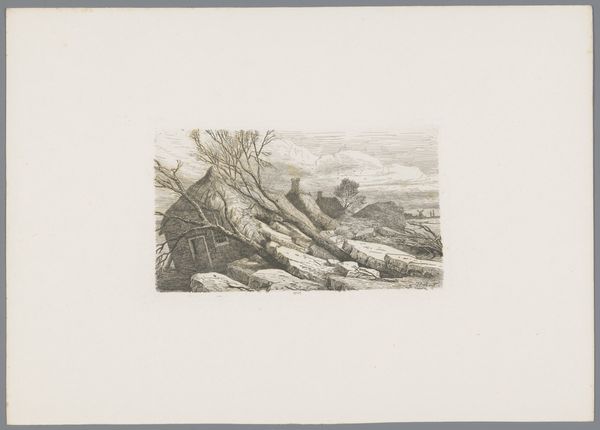
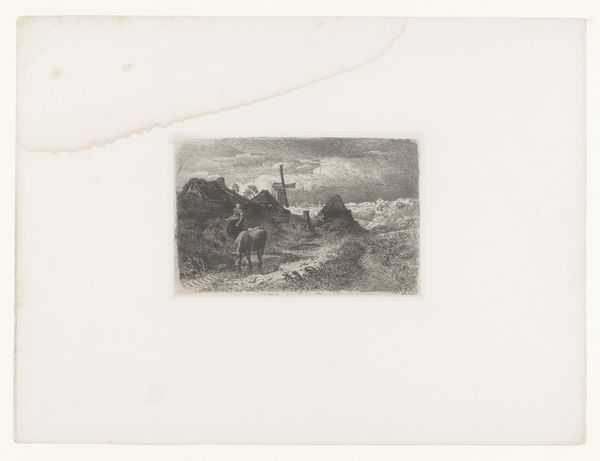
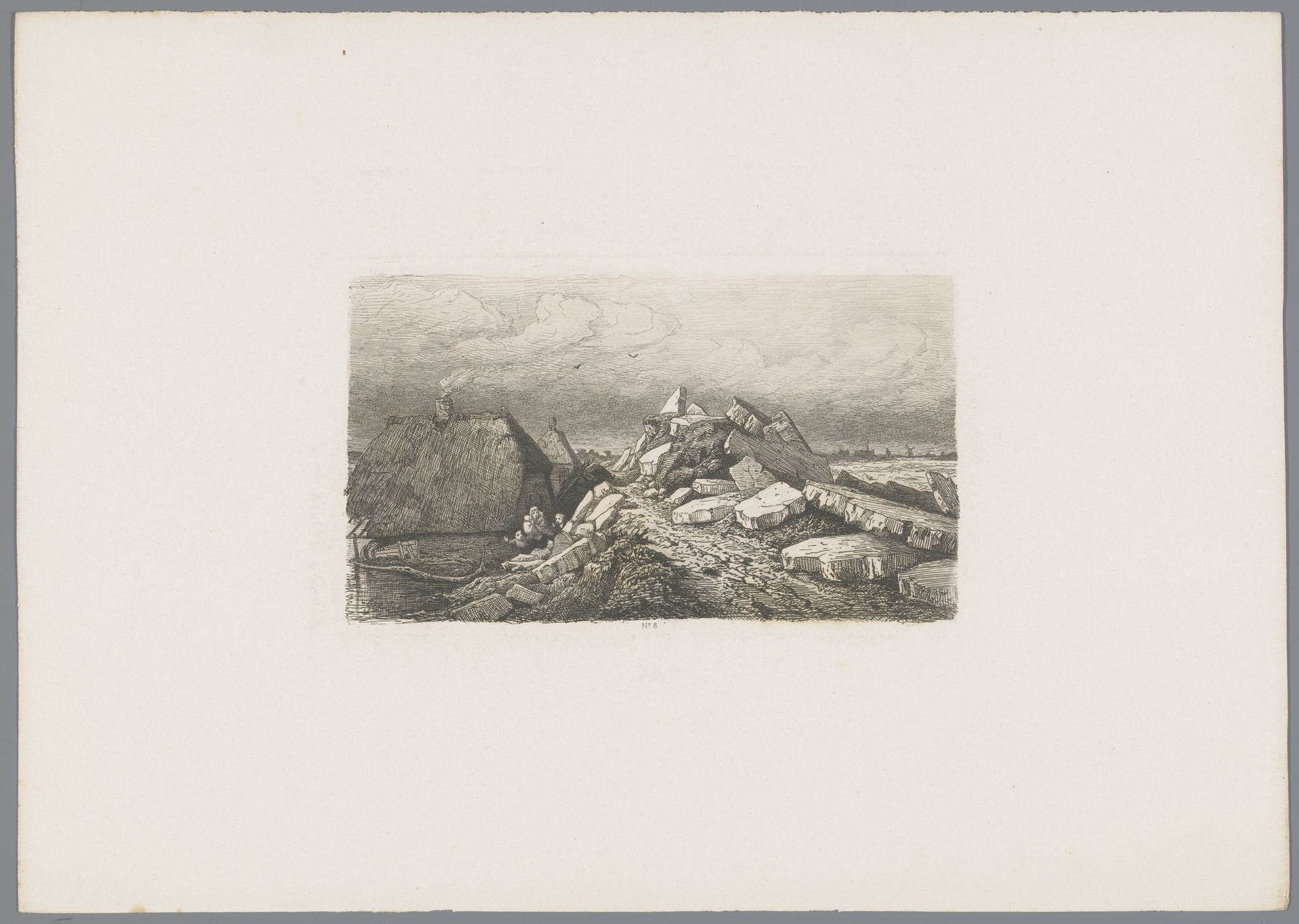
Editor: Here we have "Kruiend IJs bij Heerewaarden" from 1855, created by Pierre Louis Dubourcq using etching. It’s currently housed in the Rijksmuseum. It definitely evokes a stark and barren scene with these ice blocks dominating the landscape. How do you interpret this work, considering its composition? Curator: Considering the formal elements, note how the artist uses line and texture to create a dynamic and almost unsettling composition. The fragmented ice floes, rendered with intricate detail through etching, disrupt any sense of pictorial harmony. Do you perceive a focal point in the composition or does its power derive from something else? Editor: I don’t really see a focal point that stands out to me - I'm thinking that it is more about the relationship between textures and lines of the buildings, sky and ice, that draws your eye around the piece. Curator: Precisely. Dubourcq has arranged these masses in a way that guides the viewer's eye, prompting it to dance across the landscape. This evokes a sense of the sublime – the overwhelming power of nature rendered through the manipulation of formal properties such as tonal contrasts. It invites introspection, isn't it? Editor: It does make you contemplate. Looking closely, it feels like you could be lost amongst the blocks of ice. What have you taken away from your interpretation of this art? Curator: Considering solely the composition and execution of the piece, without concern for what the scene depicts, has shown me the profound ways artists use line, shape and tone to deliver a potent emotional punch, an example of pure visual language at its finest.

Artwork details
- Medium
- print, etching
- Dimensions
- height 300 mm, width 422 mm
- Location
- Rijksmuseum
- Copyright
- Rijks Museum: Open Domain
Tags
etching
landscape
watercolor
realism
Comments
No comments
About this artwork
Editor: Here we have "Kruiend IJs bij Heerewaarden" from 1855, created by Pierre Louis Dubourcq using etching. It’s currently housed in the Rijksmuseum. It definitely evokes a stark and barren scene with these ice blocks dominating the landscape. How do you interpret this work, considering its composition? Curator: Considering the formal elements, note how the artist uses line and texture to create a dynamic and almost unsettling composition. The fragmented ice floes, rendered with intricate detail through etching, disrupt any sense of pictorial harmony. Do you perceive a focal point in the composition or does its power derive from something else? Editor: I don’t really see a focal point that stands out to me - I'm thinking that it is more about the relationship between textures and lines of the buildings, sky and ice, that draws your eye around the piece. Curator: Precisely. Dubourcq has arranged these masses in a way that guides the viewer's eye, prompting it to dance across the landscape. This evokes a sense of the sublime – the overwhelming power of nature rendered through the manipulation of formal properties such as tonal contrasts. It invites introspection, isn't it? Editor: It does make you contemplate. Looking closely, it feels like you could be lost amongst the blocks of ice. What have you taken away from your interpretation of this art? Curator: Considering solely the composition and execution of the piece, without concern for what the scene depicts, has shown me the profound ways artists use line, shape and tone to deliver a potent emotional punch, an example of pure visual language at its finest.
Comments
No comments