About this artwork
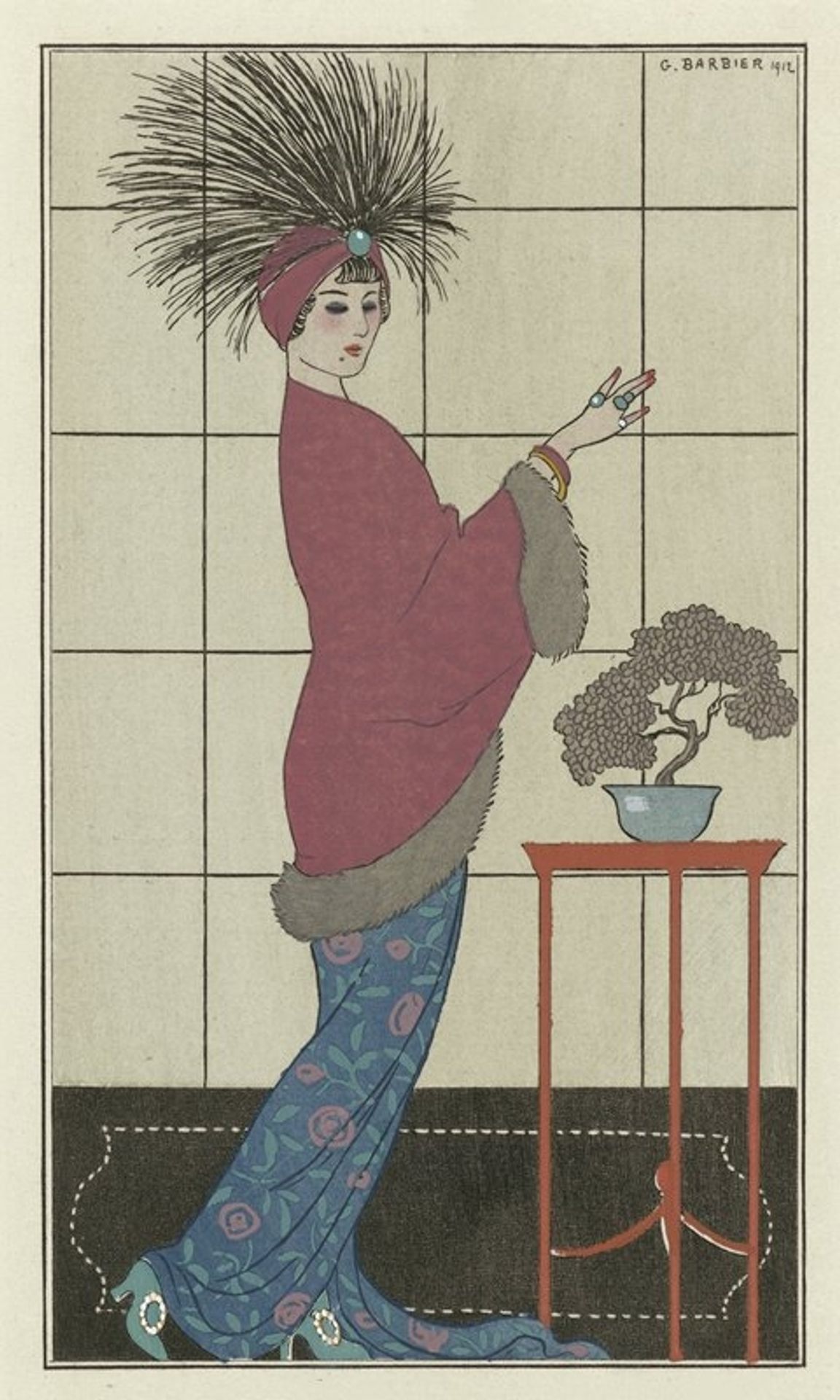
Editor: This is George Barbier's "Manteau de Damas rose" from 1912, rendered in pen and print. I'm struck by its sense of contained luxury, like a glimpse into a world of elegant artifice. The colors are so delicate. What do you see in this piece? Curator: Oh, Barbier! A window into the fleeting beauty of the Belle Époque. To me, this is a meditation on artifice, the deliberate construction of beauty. Consider that plume – absurd, impractical, utterly fabulous! Do you get a sense of the theatrical here? Editor: Definitely! It's like she's playing a role. But what's the significance of that little bonsai tree beside her? Curator: Ah, the bonsai. It introduces an element of nature tamed, controlled, made to fit within the carefully constructed environment. It’s a whisper of Zen gardens amidst the riot of feathers and fashionable fabrics, dont you think? It’s all surface and decoration, but also – perhaps – a longing for something more authentic. It’s a paradox, beautifully presented. Editor: So, it's a tension between the artificial and the natural? I hadn't considered that. Curator: Precisely! Barbier offers us these delightful visual riddles, wrapped in gorgeous gowns and elaborate headdresses. It is hard not to look for answers, no? Editor: It really does. I'll certainly see Barbier's work in a new light from now on. Thanks! Curator: My pleasure! Always remember that with art, there's as much to discover in the questions as there are in the answers, maybe even more!

Artwork details
- Medium
- drawing, print, pen
- Copyright
- Public Domain: Artvee
Tags
Comments
Share your thoughts
About this artwork
Editor: This is George Barbier's "Manteau de Damas rose" from 1912, rendered in pen and print. I'm struck by its sense of contained luxury, like a glimpse into a world of elegant artifice. The colors are so delicate. What do you see in this piece? Curator: Oh, Barbier! A window into the fleeting beauty of the Belle Époque. To me, this is a meditation on artifice, the deliberate construction of beauty. Consider that plume – absurd, impractical, utterly fabulous! Do you get a sense of the theatrical here? Editor: Definitely! It's like she's playing a role. But what's the significance of that little bonsai tree beside her? Curator: Ah, the bonsai. It introduces an element of nature tamed, controlled, made to fit within the carefully constructed environment. It’s a whisper of Zen gardens amidst the riot of feathers and fashionable fabrics, dont you think? It’s all surface and decoration, but also – perhaps – a longing for something more authentic. It’s a paradox, beautifully presented. Editor: So, it's a tension between the artificial and the natural? I hadn't considered that. Curator: Precisely! Barbier offers us these delightful visual riddles, wrapped in gorgeous gowns and elaborate headdresses. It is hard not to look for answers, no? Editor: It really does. I'll certainly see Barbier's work in a new light from now on. Thanks! Curator: My pleasure! Always remember that with art, there's as much to discover in the questions as there are in the answers, maybe even more!
Comments
Share your thoughts