About this artwork
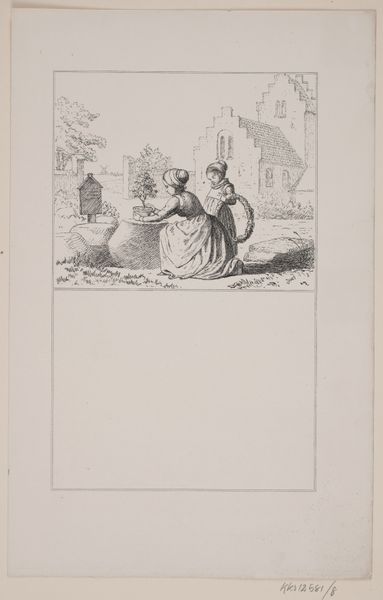
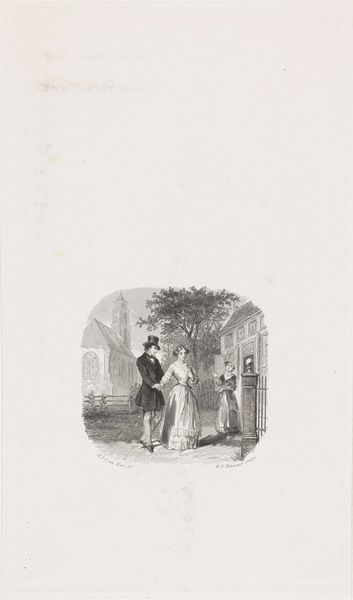
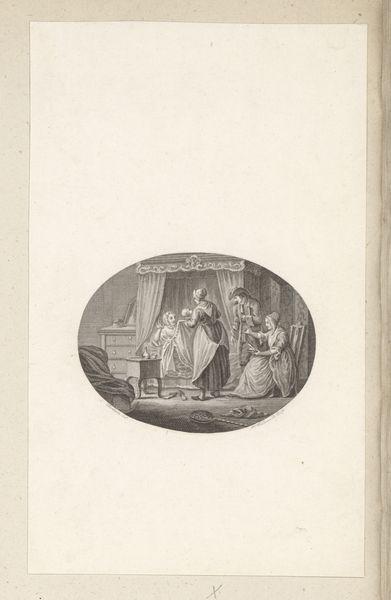
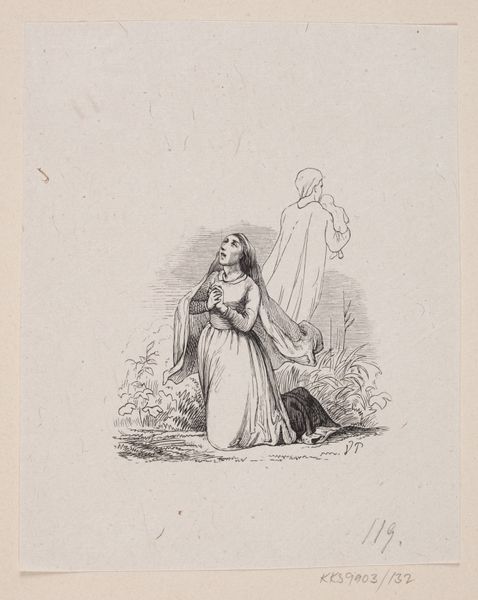
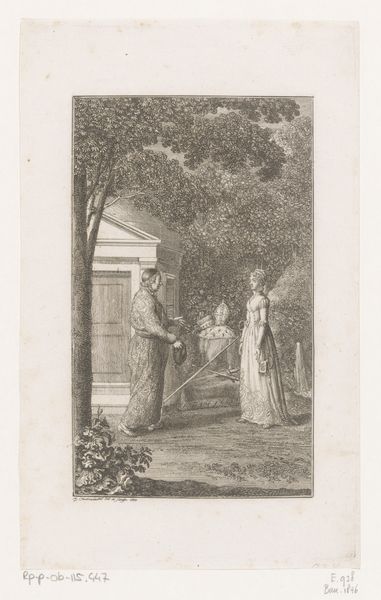
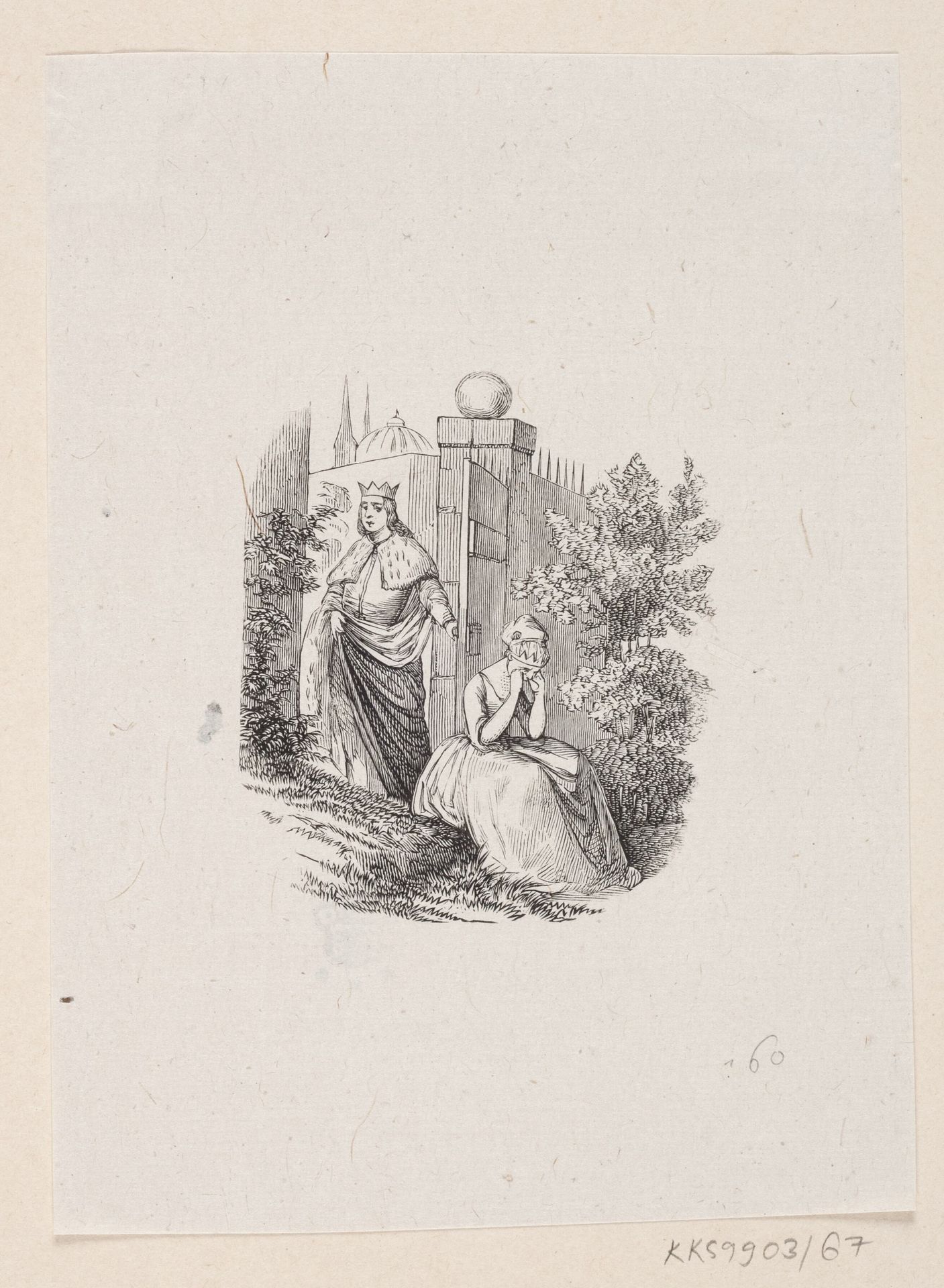
Curator: I’m struck by the overt sense of despair emanating from this print. Editor: That’s certainly present. This is an engraving made by H.P. Hansen between 1870 and 1873, titled "Illustration til 'Svinedrengen' i H.C. Andersen, 'Eventyr og Historier', Bind 1," which translates to "Illustration for 'The Swineherd' in H.C. Andersen, 'Fairy Tales and Stories,' Volume 1." It resides here at the SMK. Curator: Hansen really captures the Romanticist mood. Look at the clear, delicate lines – particularly in the dress – and the careful shading. I’m also curious about how prints like these, part of a book intended for mass consumption, shaped public perceptions of royalty and class. Editor: Exactly. We have a king figure looking dejected while the princess is heartbroken. Given that engravings such as this one required skilled labor and access to specialized materials – copper plates, inks, and the printing press – one has to ask: who was this book, and therefore this image, really for? The labor that goes into these objects is invisible, though central to its dissemination. Curator: It underscores the power of Andersen’s story to critique social climbing and the shallowness of courtly life. Hansen's illustration helps translate the story’s themes to a broader audience. These printed images, available at relatively low cost compared to paintings, disseminated particular political ideologies. Editor: And thinking about materiality, these prints were designed to be held, shared, even discarded, their value not as individual art objects necessarily, but as part of a larger narrative, embedded in a material network of production and consumption. Curator: Right, it democratizes access to visual culture but still reflects hierarchical power dynamics. These affordable illustrated books helped inscribe certain moral values and class-based assumptions onto an emerging mass audience. Editor: I think looking closely at Hansen's technique here offers insights into the processes of producing, disseminating, and ingesting such material. These engravings really shaped the circulation of imagery. Curator: Considering how visual narratives gain potency with widespread accessibility has helped contextualize this print beyond its fairytale origins. Editor: Indeed, the physical act of production, the social network of dissemination, and consumption together render this little image rich for interpretation.
Illustration til "Svinedrengen" i H.C. Andersen, "Eventyr og Historier", Bind 1
1870 - 1873


Artwork details
- Dimensions
- 140 mm (height) x 102 mm (width) (bladmaal)
- Location
- SMK - Statens Museum for Kunst
Comments
Share your thoughts
About this artwork
Curator: I’m struck by the overt sense of despair emanating from this print. Editor: That’s certainly present. This is an engraving made by H.P. Hansen between 1870 and 1873, titled "Illustration til 'Svinedrengen' i H.C. Andersen, 'Eventyr og Historier', Bind 1," which translates to "Illustration for 'The Swineherd' in H.C. Andersen, 'Fairy Tales and Stories,' Volume 1." It resides here at the SMK. Curator: Hansen really captures the Romanticist mood. Look at the clear, delicate lines – particularly in the dress – and the careful shading. I’m also curious about how prints like these, part of a book intended for mass consumption, shaped public perceptions of royalty and class. Editor: Exactly. We have a king figure looking dejected while the princess is heartbroken. Given that engravings such as this one required skilled labor and access to specialized materials – copper plates, inks, and the printing press – one has to ask: who was this book, and therefore this image, really for? The labor that goes into these objects is invisible, though central to its dissemination. Curator: It underscores the power of Andersen’s story to critique social climbing and the shallowness of courtly life. Hansen's illustration helps translate the story’s themes to a broader audience. These printed images, available at relatively low cost compared to paintings, disseminated particular political ideologies. Editor: And thinking about materiality, these prints were designed to be held, shared, even discarded, their value not as individual art objects necessarily, but as part of a larger narrative, embedded in a material network of production and consumption. Curator: Right, it democratizes access to visual culture but still reflects hierarchical power dynamics. These affordable illustrated books helped inscribe certain moral values and class-based assumptions onto an emerging mass audience. Editor: I think looking closely at Hansen's technique here offers insights into the processes of producing, disseminating, and ingesting such material. These engravings really shaped the circulation of imagery. Curator: Considering how visual narratives gain potency with widespread accessibility has helped contextualize this print beyond its fairytale origins. Editor: Indeed, the physical act of production, the social network of dissemination, and consumption together render this little image rich for interpretation.
Comments
Share your thoughts