About this artwork
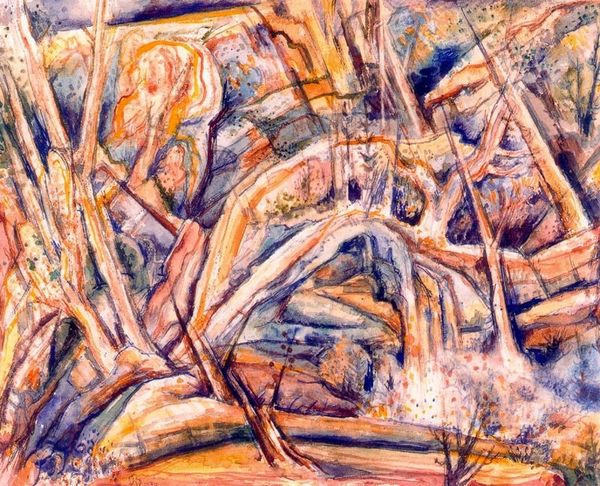
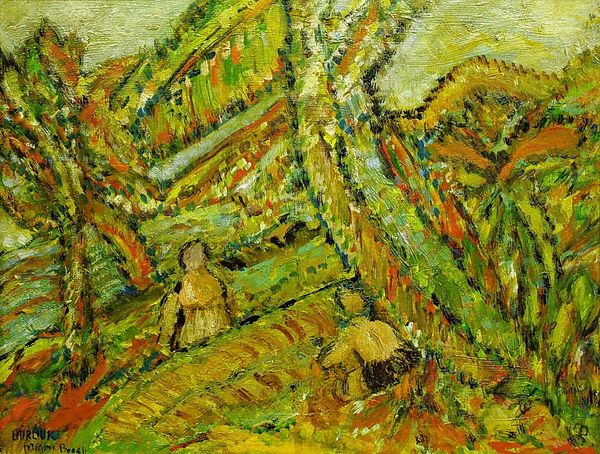
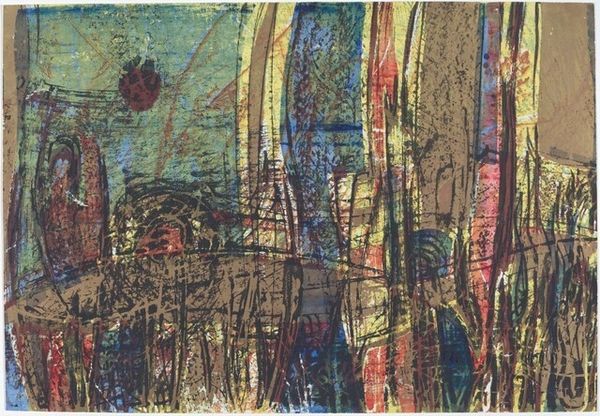
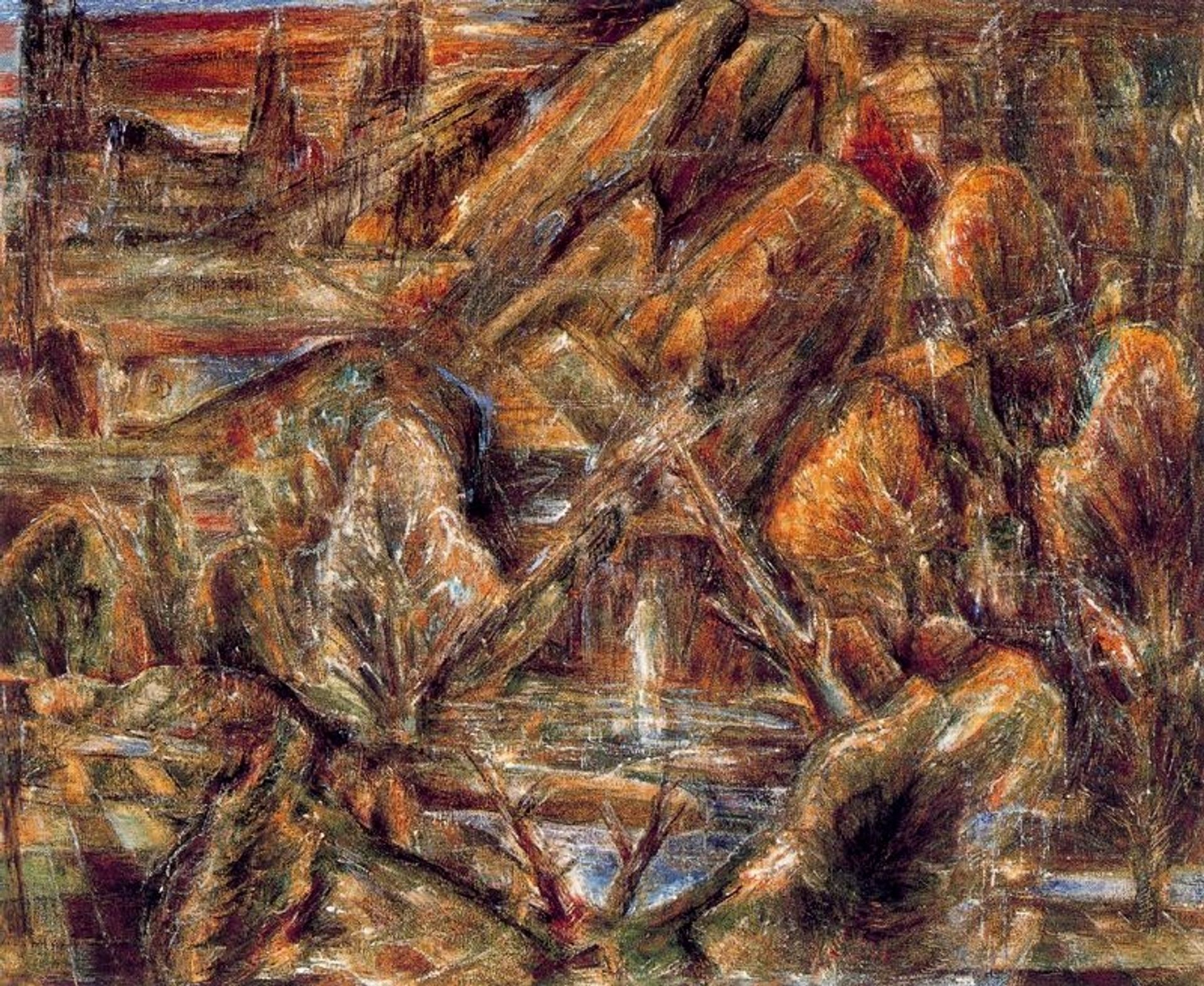
Editor: This is Albert Bloch's "Jordan," created in 1946 using oil paint. The earth tones give it a very organic, almost geological feel. How do you interpret this work? Curator: Considering Bloch's Jewish heritage and the year this was painted, shortly after the Holocaust, I can’t help but view "Jordan" through a socio-political lens. Do you see how the abstracted landscape, with its forceful brushstrokes, evokes a sense of both upheaval and resilience? Editor: I hadn't considered it in that context. I was mainly drawn to the composition itself and its colors, which felt pretty, until you put it that way. The browns and oranges suddenly look harsh. Curator: Exactly. The seemingly simple palette reflects the earth, but also perhaps a scarred earth, burdened by recent history. The name "Jordan" adds another layer – it’s a place of historical and spiritual significance, potentially referencing longing and displacement. Does that change your perspective? Editor: Definitely. It shifts from being purely aesthetic to deeply meaningful, even a little mournful. It feels less like a landscape and more like a commentary on a wounded world. Curator: And how does the expressionistic style, a way of conveying emotion over realistic representation, contribute to this reading, do you think? Editor: I think it intensifies the emotional impact. The abstract expressionism suggests a reality that is broken, not easily defined or represented directly. Curator: Precisely. It demonstrates the power of art to hold historical trauma and project forward a new understanding of expression in a turbulent period of Modernism. Editor: I’ll definitely look at abstract art differently now, with a bigger appreciation of their capacity for political statement and cultural reflection. Thanks for illuminating this. Curator: My pleasure. It is so crucial to remember that art is not made in a vacuum; that it’s always talking to its historical context, even if it doesn't appear obvious at first glance.

Artwork details
- Copyright
- Albert Bloch,Fair Use
Comments
Be the first to share your thoughts about this work.
About this artwork
Editor: This is Albert Bloch's "Jordan," created in 1946 using oil paint. The earth tones give it a very organic, almost geological feel. How do you interpret this work? Curator: Considering Bloch's Jewish heritage and the year this was painted, shortly after the Holocaust, I can’t help but view "Jordan" through a socio-political lens. Do you see how the abstracted landscape, with its forceful brushstrokes, evokes a sense of both upheaval and resilience? Editor: I hadn't considered it in that context. I was mainly drawn to the composition itself and its colors, which felt pretty, until you put it that way. The browns and oranges suddenly look harsh. Curator: Exactly. The seemingly simple palette reflects the earth, but also perhaps a scarred earth, burdened by recent history. The name "Jordan" adds another layer – it’s a place of historical and spiritual significance, potentially referencing longing and displacement. Does that change your perspective? Editor: Definitely. It shifts from being purely aesthetic to deeply meaningful, even a little mournful. It feels less like a landscape and more like a commentary on a wounded world. Curator: And how does the expressionistic style, a way of conveying emotion over realistic representation, contribute to this reading, do you think? Editor: I think it intensifies the emotional impact. The abstract expressionism suggests a reality that is broken, not easily defined or represented directly. Curator: Precisely. It demonstrates the power of art to hold historical trauma and project forward a new understanding of expression in a turbulent period of Modernism. Editor: I’ll definitely look at abstract art differently now, with a bigger appreciation of their capacity for political statement and cultural reflection. Thanks for illuminating this. Curator: My pleasure. It is so crucial to remember that art is not made in a vacuum; that it’s always talking to its historical context, even if it doesn't appear obvious at first glance.
Comments
Be the first to share your thoughts about this work.