About this artwork
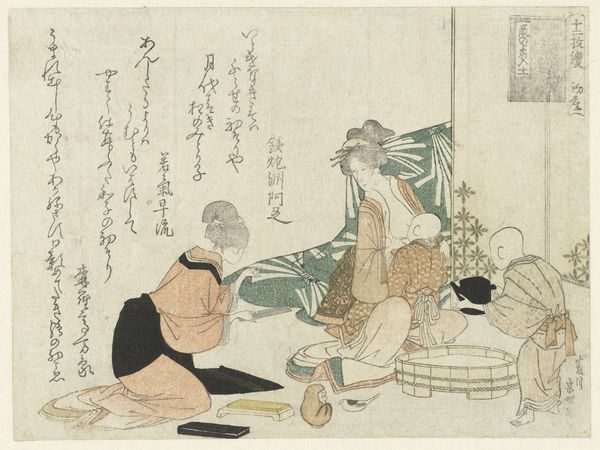
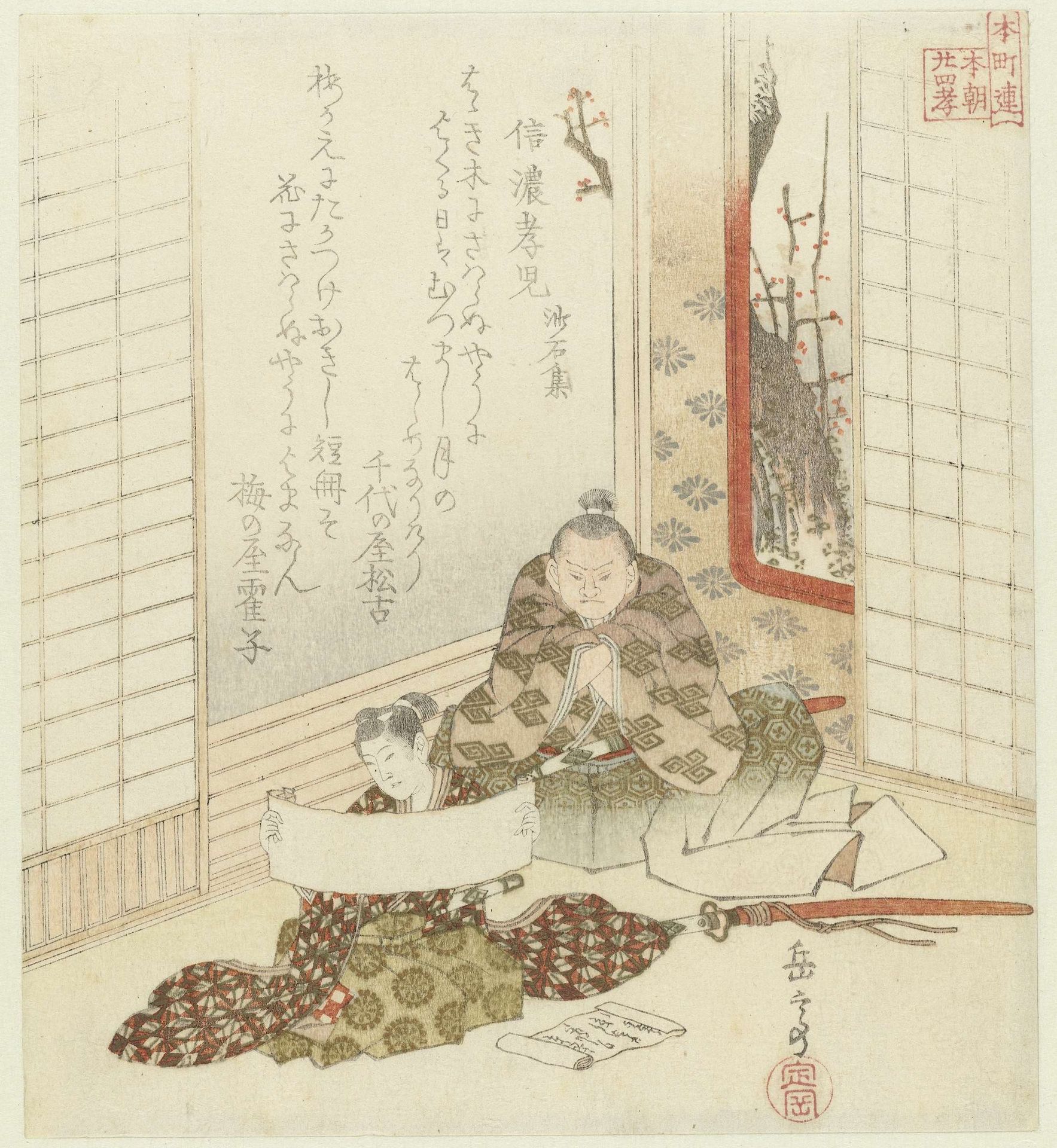
This woodblock print, "Twenty-four Japanese Examples of Filial Piety," by Yashima Gakutei, presents us with a poignant scene of familial duty. A young woman is seen reading aloud to a seated man who is listening intently, a sword laying discarded on the floor next to him. The most striking motif here is perhaps the scroll itself, an ancient symbol of knowledge and tradition, a vessel containing the wisdom of ancestors, passed down through generations. The act of reading, especially aloud, transforms into a ritual, a conduit connecting the present to the past. Consider how, in ancient Greece, similar scrolls carried the epic poems of Homer, recited to instill cultural values and heroic ideals. The simple gesture of reading transcends time. It embodies a deep-seated human desire to preserve, transmit, and honor the stories that define us. We are all, it seems, bound by the invisible threads of memory, seeking solace and meaning in the narratives of those who came before.
Twenty-four Japanese examples of filial piety for the Honchôren
c. 1821

Yashima Gakutei 屋島岳亭
1786 - 1868Location
RijksmuseumArtwork details
- Medium
- print, woodblock-print
- Dimensions
- height 202 mm, width 183 mm
- Location
- Rijksmuseum
- Copyright
- Rijks Museum: Open Domain
Tags
Comments
Share your thoughts
About this artwork
This woodblock print, "Twenty-four Japanese Examples of Filial Piety," by Yashima Gakutei, presents us with a poignant scene of familial duty. A young woman is seen reading aloud to a seated man who is listening intently, a sword laying discarded on the floor next to him. The most striking motif here is perhaps the scroll itself, an ancient symbol of knowledge and tradition, a vessel containing the wisdom of ancestors, passed down through generations. The act of reading, especially aloud, transforms into a ritual, a conduit connecting the present to the past. Consider how, in ancient Greece, similar scrolls carried the epic poems of Homer, recited to instill cultural values and heroic ideals. The simple gesture of reading transcends time. It embodies a deep-seated human desire to preserve, transmit, and honor the stories that define us. We are all, it seems, bound by the invisible threads of memory, seeking solace and meaning in the narratives of those who came before.
Comments
Share your thoughts