About this artwork
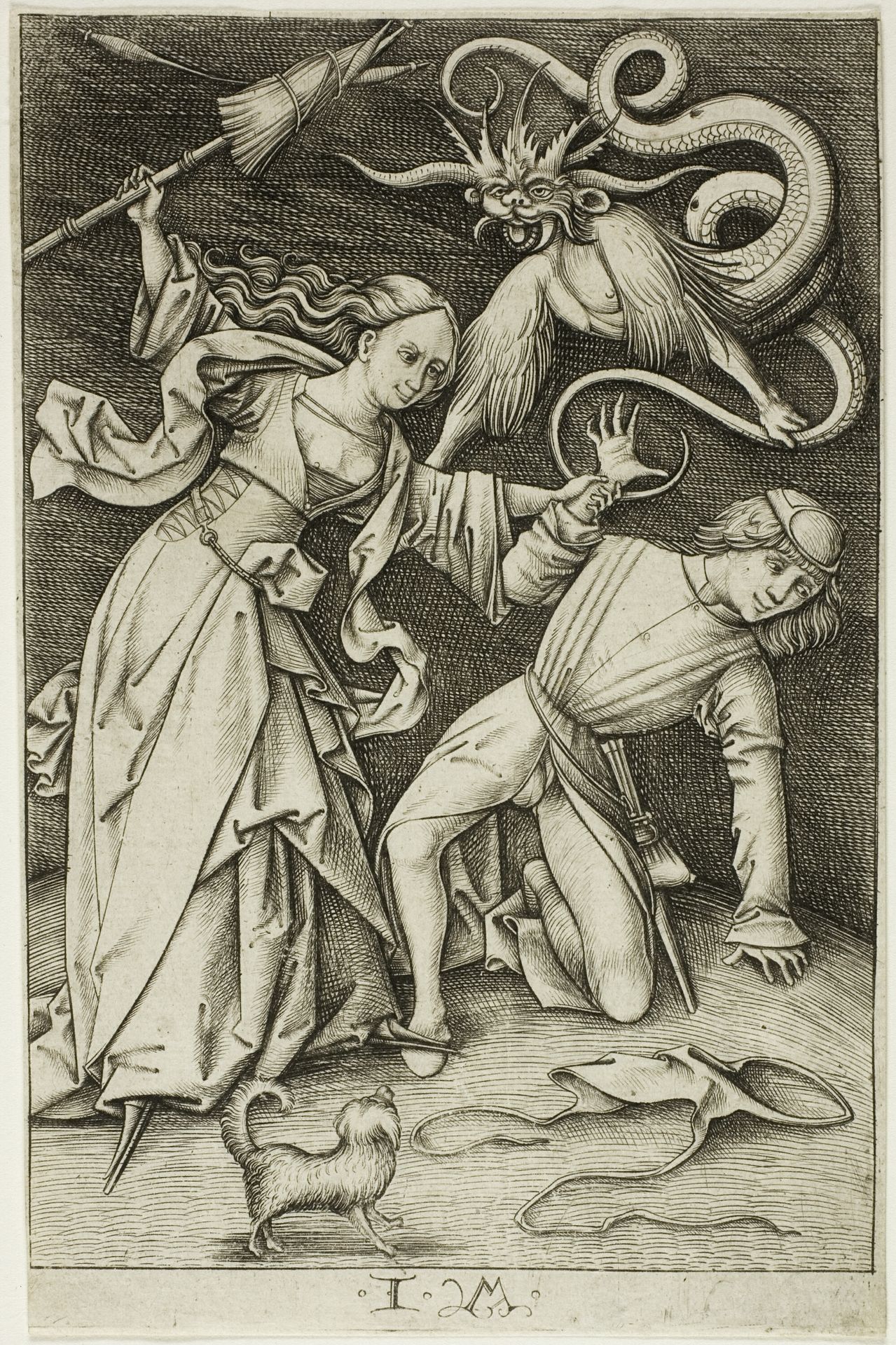
Israhel van Meckenem created this engraving titled, "The Fight over the Trousers," sometime in the late fifteenth century. The image is dominated by a dynamic composition of diagonal lines and contrasting textures that immediately draw the eye. The scene depicts a woman with a broom, locked in a struggle with a man over a pair of trousers, while a devil looms above them. Consider how van Meckenem uses the contrast between light and shadow to define the forms, creating a sense of depth and tension. The detailed cross-hatching, particularly visible in the background, adds to the density of the scene, intensifying the conflict. The figures' expressive gestures and the presence of the devil introduce a narrative element, hinting at broader cultural anxieties around gender roles and moral order. This artwork presents a complex interplay of domestic conflict, gender dynamics, and moral allegory. By looking closely at its formal qualities, we can begin to decode the cultural codes embedded within.
The Fight over the Trousers c. 1495


Artwork details
- Medium
- drawing, print, paper, engraving
- Dimensions
- 168 × 109 mm
- Location
- The Art Institute of Chicago
- Copyright
- Public Domain
Tags
drawing
medieval
narrative-art
caricature
caricature
figuration
paper
genre-painting
history-painting
northern-renaissance
engraving
Comments
No comments
About this artwork
Israhel van Meckenem created this engraving titled, "The Fight over the Trousers," sometime in the late fifteenth century. The image is dominated by a dynamic composition of diagonal lines and contrasting textures that immediately draw the eye. The scene depicts a woman with a broom, locked in a struggle with a man over a pair of trousers, while a devil looms above them. Consider how van Meckenem uses the contrast between light and shadow to define the forms, creating a sense of depth and tension. The detailed cross-hatching, particularly visible in the background, adds to the density of the scene, intensifying the conflict. The figures' expressive gestures and the presence of the devil introduce a narrative element, hinting at broader cultural anxieties around gender roles and moral order. This artwork presents a complex interplay of domestic conflict, gender dynamics, and moral allegory. By looking closely at its formal qualities, we can begin to decode the cultural codes embedded within.
Comments
No comments