print, paper, woodcut
# print
#
landscape
#
german-expressionism
#
figuration
#
paper
#
female-nude
#
expressionism
#
woodcut
#
nude
Copyright: Public domain
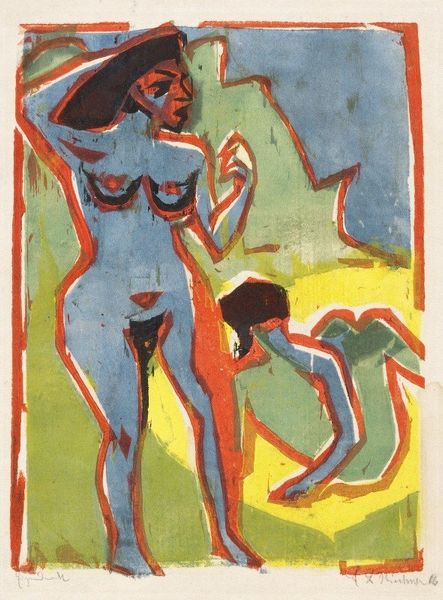
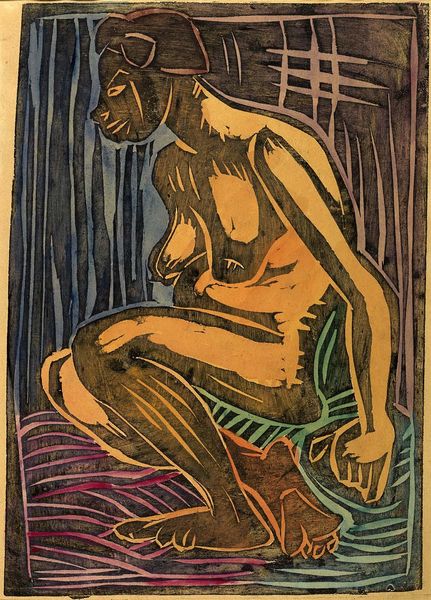
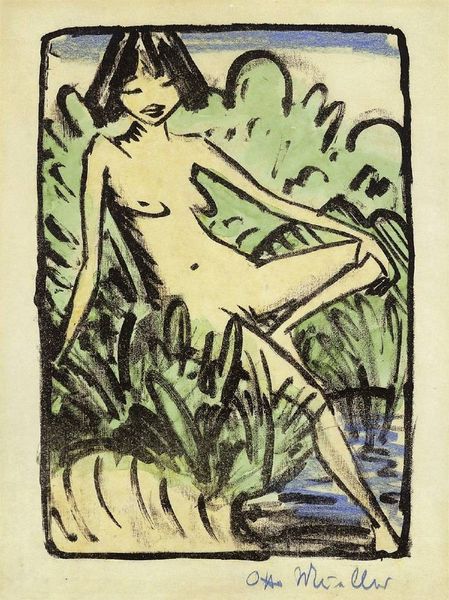
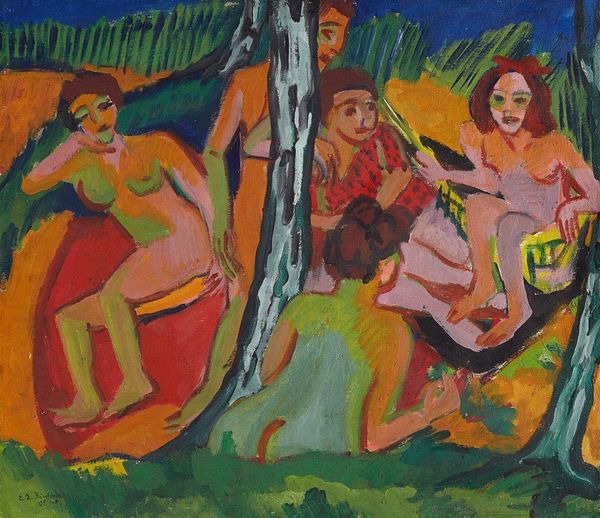
Editor: We’re looking at "Bathing Women between White Rocks" by Ernst Ludwig Kirchner, a woodcut print on paper. There’s a striking roughness to it; the angular figures and stark contrast create a sense of tension despite the seemingly serene subject matter. What can you tell me about this work in terms of its historical and cultural context? Curator: The woodcut medium itself carries historical weight. Think of its use in disseminating popular imagery and political propaganda. Kirchner, deeply involved with Die Brücke, used it to engage with societal anxieties. His interest in "primitive" art also influenced his technique. The deliberately crude lines challenge academic art traditions and the bourgeois expectations of beauty, embodying the Expressionist desire to shock and provoke. How do you read the figures within that framework? Editor: So, it's a rejection of traditional aesthetics and values. I suppose I see their almost confrontational poses and somewhat mask-like faces echoing that. It’s as if they are presenting an idealized but also uncomfortable version of freedom. The white rocks appear oppressive almost. Curator: Precisely. Consider how rapid industrialization and urbanization during that period altered people's relationship with nature. These women situated "between" the white rocks – are they seeking refuge, or are they also trapped by it? Their nakedness is not simply erotic; it’s vulnerable, placed against the sharp, fragmented landscape. Kirchner's art, although drawing from nature, constantly filtered it through the lens of societal unease. Editor: I never considered the "between" aspect so literally. Now it seems they are quite stuck there. So it reflects on societal anxiety of losing yourself amidst changing landscapes of industrialization and its new values? I definitely see it differently now! Curator: Yes, thinking about its reception in the art world. Its expressionistic qualities offered social commentary, something embraced or denounced by the people that reviewed them back then. The piece then becomes a statement of society's values at that moment in time. I hope you enjoyed that explanation. Editor: Yes, that really expanded my understanding and gave it another interesting layer, thank you!
Comments
No comments
Be the first to comment and join the conversation on the ultimate creative platform.
 Collect
 React
React Comment
More like this