drawing, print, paper, ink, pen, charcoal
#
drawing
#
allegory
# print
#
sculpture
#
charcoal drawing
#
figuration
#
paper
#
11_renaissance
#
ink
#
pen
#
charcoal
#
history-painting
#
academic-art
#
charcoal
Dimensions: 283 × 219 mm
Copyright: Public Domain
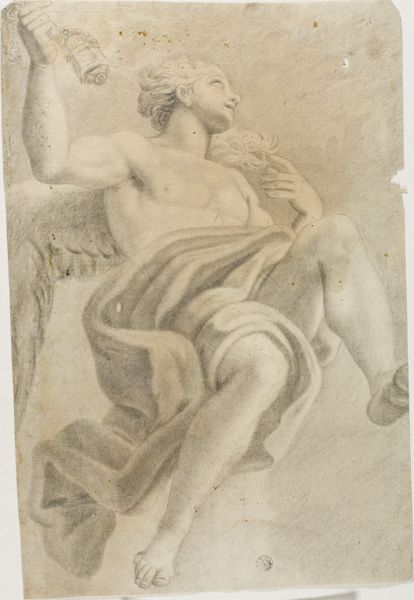
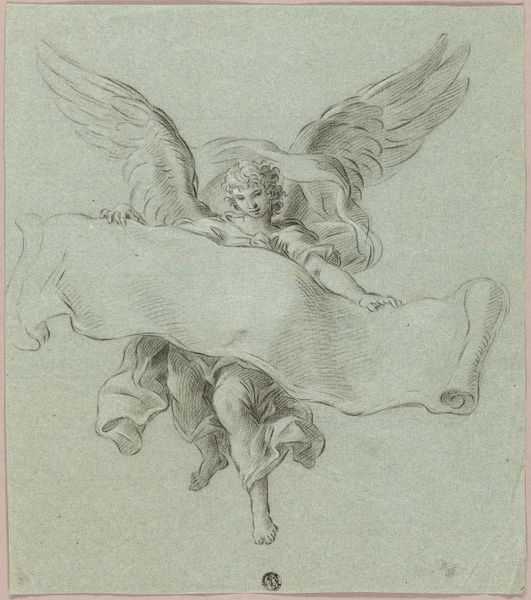
Curator: Here we have Giorgio Vasari's "Allegory of Eternity," dating from 1544 to 1545. It’s currently held at The Art Institute of Chicago. Looking closely, it seems to be executed with pen, ink, and charcoal on paper. Editor: My first impression is of a tranquil divinity, an angel calmly perched atop a sphere. The radiating lines behind its head suggest transcendence. It feels both grand and intimate somehow. Curator: The work's materiality, especially the visible grid underneath the drawing, speaks volumes about the process. It reveals a workshop practice, perhaps a preparatory sketch for a larger, more permanent piece, showing how art production in the Renaissance involved careful planning and labor. We're not just seeing an idea, but a specific phase of artistic work. Editor: Absolutely, and beyond the workshop, note how the angel firmly planted on the globe, that has "Eternitas" inscribed on it, visually anchors the concept. The upward gaze and the flame she holds imply both illumination and everlasting life. This layering of symbolism – the globe, the flame, the figure – seems quite deliberate, aiming to connect terrestrial existence to the divine and timeless. Curator: From a materials standpoint, even the choice of paper matters. It's not merely a surface, but an economic reality. Access to quality paper, to these pigments, it defines who could participate in artistic production. And, it sets a certain standard for preservation as it became an item worthy of archiving. Editor: Yes, and think about how those materials transmit cultural memory too. Charcoal echoes ancient drawing practices; ink allows for precise lines to define iconographic details – wings, the direction of the eyes. The Renaissance was obsessed with reviving and reinterpreting classical symbols, blending them into contemporary Christian contexts. The angel is a perfect example. Curator: In effect, it pushes against traditional definitions. Is it fine art or craft? The "Allegory of Eternity" demands we acknowledge art-making as a convergence of idea, technique, labor, and, significantly, available materials. It shows that eternity needs labor! Editor: Well put. For me, encountering this artwork highlights the enduring power of symbols to translate complex ideas, to tap into universal feelings surrounding mortality, and to connect the human spirit to something lasting. Curator: For me, thinking about production and consumption brings to mind all the unrecognized labor and often overlooked people involved in artistic creation. It challenges the focus only on the masters. Editor: I leave this dialogue seeing not only an artistic creation but an exploration of profound themes—Vasari delivers food for thought.
Comments
No comments
Be the first to comment and join the conversation on the ultimate creative platform.
 Collect
 React
React Comment
More like this