About this artwork
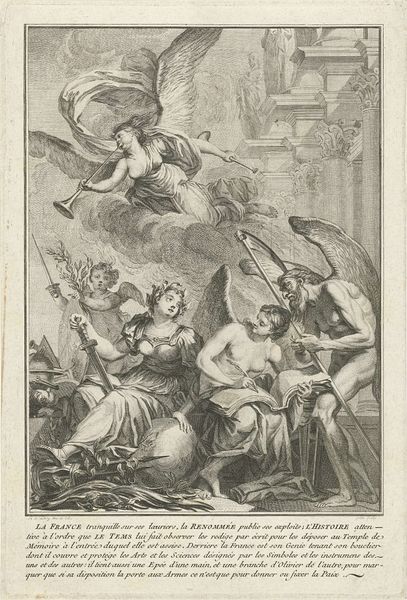
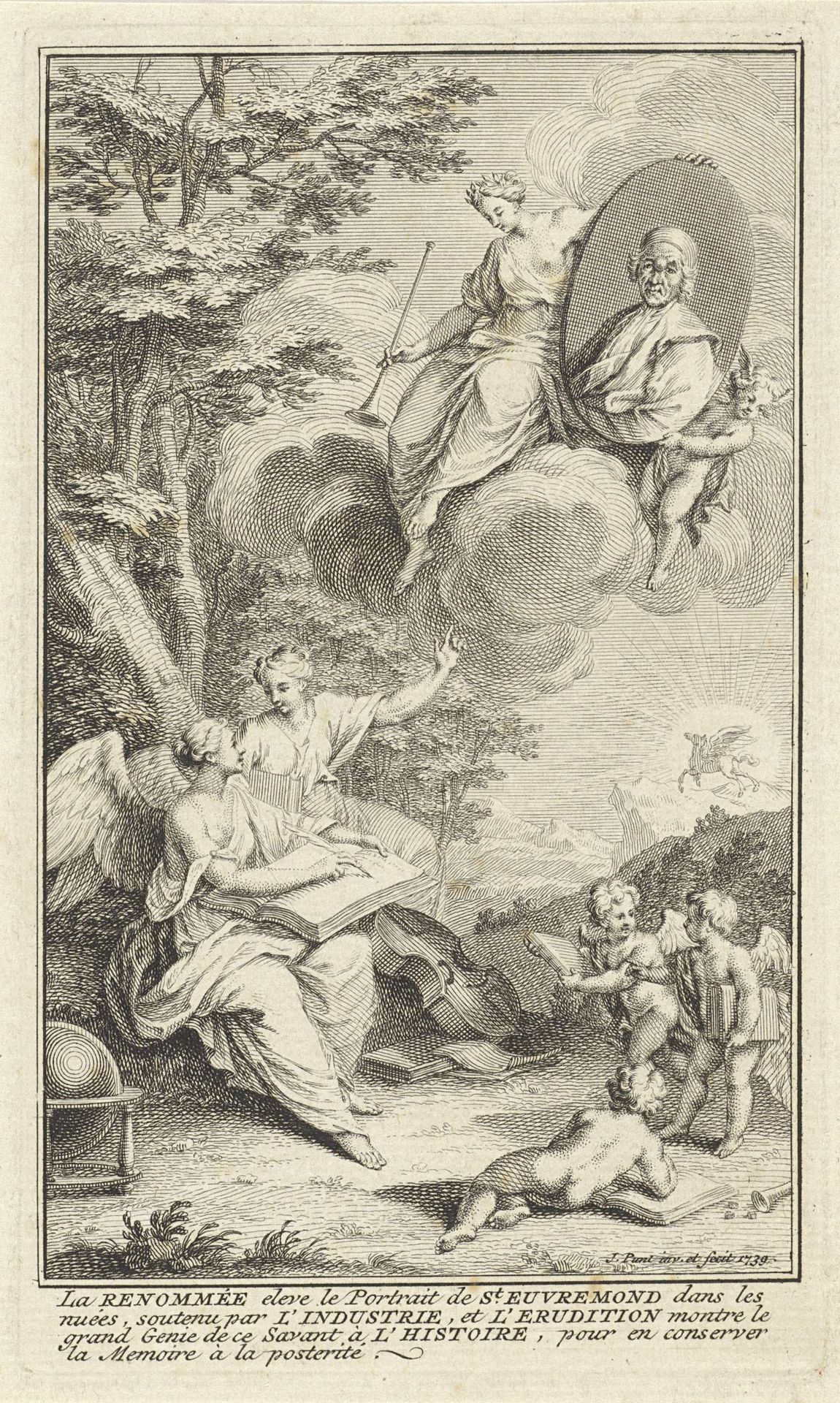
Curator: Well, here we have Jan Punt's engraving from 1739, a real baroque feast for the eyes titled "Allegorical title page with the portrait of Charles de Saint-Évremond." What's your immediate take? Editor: The flurry of activity, cherubs wrestling, goddesses trumpeting... it feels celebratory, but also a bit chaotic. All that classical imagery! I’m interested to unpack whose celebration we’re witnessing here. Curator: Saint-Évremond was quite the celebrated figure. Think wit, libertine, exile… this engraving essentially immortalizes him. See how Fame lifts his portrait into the clouds, supported by Industry and Erudition? The very picture of Enlightenment values. Editor: Mmh, yes, the glorification of the male intellectual. It’s fascinating how these allegories worked to reinforce very specific societal power structures. Note how History, on the lower left, is busily writing it all down. What stories are being centered? What voices are intentionally left out? Curator: It’s not subtle, is it? Still, there's something appealing in its over-the-topness. The meticulous details, the swirling clouds… Look at the light playing across the figures. Editor: Absolutely. The skill in capturing different textures through engraving is remarkable, almost painterly. And the inclusion of the globe—suggests a universal intellectual aspiration. Except who has access to that universe, right? The chosen few… Curator: It makes you think, doesn't it, about who gets remembered and how. I’m left contemplating the act of canonization. Editor: Right, it asks us to examine whose stories we’re constantly retelling, whose faces are immortalized, and maybe it nudges us toward writing our own allegories—ones that truly reflect the multiplicity of human experience.
Allegorische titelpagina met het portret van Charles de Saint-Évremond
1739

Jan Punt
1711 - 1779Location
RijksmuseumArtwork details
- Medium
- engraving
- Dimensions
- height 141 mm, width 84 mm
- Location
- Rijksmuseum
- Copyright
- Rijks Museum: Open Domain
Tags
portrait
allegory
baroque
old engraving style
history-painting
engraving
Comments
Be the first to share your thoughts about this work.
About this artwork
Curator: Well, here we have Jan Punt's engraving from 1739, a real baroque feast for the eyes titled "Allegorical title page with the portrait of Charles de Saint-Évremond." What's your immediate take? Editor: The flurry of activity, cherubs wrestling, goddesses trumpeting... it feels celebratory, but also a bit chaotic. All that classical imagery! I’m interested to unpack whose celebration we’re witnessing here. Curator: Saint-Évremond was quite the celebrated figure. Think wit, libertine, exile… this engraving essentially immortalizes him. See how Fame lifts his portrait into the clouds, supported by Industry and Erudition? The very picture of Enlightenment values. Editor: Mmh, yes, the glorification of the male intellectual. It’s fascinating how these allegories worked to reinforce very specific societal power structures. Note how History, on the lower left, is busily writing it all down. What stories are being centered? What voices are intentionally left out? Curator: It’s not subtle, is it? Still, there's something appealing in its over-the-topness. The meticulous details, the swirling clouds… Look at the light playing across the figures. Editor: Absolutely. The skill in capturing different textures through engraving is remarkable, almost painterly. And the inclusion of the globe—suggests a universal intellectual aspiration. Except who has access to that universe, right? The chosen few… Curator: It makes you think, doesn't it, about who gets remembered and how. I’m left contemplating the act of canonization. Editor: Right, it asks us to examine whose stories we’re constantly retelling, whose faces are immortalized, and maybe it nudges us toward writing our own allegories—ones that truly reflect the multiplicity of human experience.
Comments
Be the first to share your thoughts about this work.